What Does Incentivized Review Mean for Merchants
Learn what does incentivized review mean for Square merchants, how it impacts trust and compliance, and what to consider before offering incentives.
An incentivized review is feedback written after a customer receives something of value, such as a discount, money, or a free service, and research found average ratings of 4.722 stars for incentivized reviews versus 4.333 for nonincentivized reviews, a 0.39-star gap. The reward can't be tied, directly or indirectly, to leaving a positive rating, and some platforms prohibit customer review incentives altogether.
You finish a great haircut, massage, facial, or personal training session. The client is smiling at the front desk and says, “I should leave you a review.” You want to make that easy, but you may also wonder whether offering a discount or free add-on would help them follow through.
For Square merchants, the answer depends on what the reward is connected to and where the review will appear. A referral reward for bringing a new customer is a different activity from a reward for posting, changing, or removing a review. That distinction lets salons, barbershops, spas, and fitness studios grow through genuine word of mouth without putting a Google Business Profile at risk.
Table of Contents
- What Does Incentivized Review Mean
- The FTC Rules on Incentives and Sentiment
- Google Business Profile and Store Rating Policies
- The Hidden Risks of Inflated Ratings
- Safe Alternatives Using ViralRef for Square
- Best Practices for Service Businesses
What Does Incentivized Review Mean
Suppose a client books a haircut through Square Appointments. After the service, you offer a discount on their next visit if they write a review. That review is incentivized because the customer received something of value in connection with providing feedback.
The value might be money, a discount, a free product, a complimentary service, or another material benefit. The important question isn't whether the customer enjoyed the appointment. It's whether the reward was offered for the act of reviewing, and whether you influenced what the customer was expected to say.
The Federal Trade Commission's guidance for platforms explains that an incentive can't be conditioned, explicitly or implicitly, on a positive review. The same guidance warns that even an incentive not tied to positive sentiment can affect how readers interpret the review, because the material connection may introduce bias.
The plain-English distinction
There are two very different requests a business can make:
- Feedback request: “Share your experience with us.”
- Rating request: “Give us five stars and receive a discount.”
The first asks for an opinion without dictating the opinion. The second pays for a desired sentiment. A request such as “leave us a positive review” can also create a problem, even if you never mention a particular star rating.
For a salon owner, this matters when a loyal customer posts a review after receiving a complimentary treatment. For a fitness studio, it matters when members receive account credit only after praising a class. For a spa, it matters when staff privately asks unhappy clients not to post publicly in exchange for a free service.
Practical rule: Reward a new customer for being referred, not an existing customer for saying something favorable.
Businesses often want more feedback because satisfied customers forget to write it. A referral program can turn customers into advocates without making their public opinions part of the transaction. This guide to how to turn customers into advocates is useful when your real goal is word-of-mouth growth rather than a larger review count.
You can also separate the two workflows in your Square operation. Ask every customer for honest feedback through a normal, voluntary request. Build rewards around referrals, repeat visits, or participation in a loyalty program instead. For more context on using rewards responsibly, see incentives in marketing.
The FTC Rules on Incentives and Sentiment
The FTC doesn't treat every incentivized review as automatically forbidden under U.S. policy. Its central concern is whether a business has connected the reward to a favorable opinion.
The FTC's Consumer Reviews and Testimonials Rule questions and answers state that businesses may provide incentives for consumer reviews, but the incentive can't be tied, explicitly or implicitly, to positive sentiment. A review rewarded only because it is favorable would violate the rule even if the reviewer discloses the incentive.
That creates a clear difference between paying for effort and paying for opinion.
| Business request | What it rewards | Compliance concern |
|---|---|---|
| “Share honest feedback about your appointment.” | The act of providing feedback | The incentive still needs to fit the platform's rules and may require disclosure |
| “Leave a five-star review for a discount.” | A favorable rating | Prohibited sentiment conditioning |
| “Change your review to five stars and receive a free service.” | A revised positive opinion | Prohibited manipulation |
| “Refer a friend who books and receive account credit.” | A completed referral | Separate from rewarding a review |
A salon might offer a coupon to every client who completes a feedback form, regardless of whether the comments are positive, neutral, or negative. That arrangement still needs careful review of the destination platform's policy and clear disclosure of the material connection. It also shouldn't be presented as an organic customer experience.
Why disclosure isn't a cure-all
Disclosure matters because readers should know when a reviewer received something of value. But disclosure doesn't make a positive-only campaign acceptable. “This reviewer received a discount for giving us five stars” is still a reward tied to favorable sentiment.
The FTC's position also recognizes that a disclosed incentive can influence how readers evaluate credibility. A customer may write sincerely, yet readers can reasonably give that review less weight because the business created a financial reason to participate.
That is why “5 stars or get a discount” is the wrong structure for a Square merchant. It asks your customer to perform two jobs at once, provide feedback and promote the business. A safer request separates the activities: invite honest feedback without pressure, then use a referral system to reward customers who introduce someone new.
Don't use review gating either. Sending delighted customers to Google while routing unhappy customers to a private form creates a distorted picture of customer experience. Give customers the same voluntary opportunity to share feedback, and respond professionally when the comments aren't flattering.
Google Business Profile and Store Rating Policies
Google's rules are stricter than the FTC's general position. Under Google Business Profile's prohibited content policy, merchants can't offer free or discounted goods or services in exchange for posting, changing, or removing reviews. Google classifies that practice as fake and misleading content.
For a local business, the practical result is simple. A reward that might be permissible under a general U.S. disclosure analysis can still violate the rules of the platform where your review appears.
What Google prohibits
A barbershop shouldn't offer a free beard trim for a Google review. A spa shouldn't offer a discounted massage for changing a two-star review. A fitness studio shouldn't promise account credit for posting feedback after a class.
Google's policy covers incentives connected to:
- Posting a review: The customer receives something for submitting feedback.
- Changing a review: The customer receives something for editing a rating or comment.
- Removing a review: The customer receives something for taking criticism down.
- Discounted or free services: The reward has value even when no cash changes hands.
The Google Store Rating Partner Requirements go further for merchant review feeds. They don't allow financial incentives for reviews, including free samples, gift cards, or discounts on future purchases, and providers must remove incentivized reviews when they discover a violation.
That difference matters for businesses using Google Maps and Search to attract nearby clients. A review campaign isn't isolated from your local presence. It can affect the trustworthiness of the profile customers inspect before booking a stylist, trainer, or massage therapist.
Keep review collection and referrals separate
You can ask customers to share an honest experience without offering compensation. You can also give customers a reward when a referred friend books and pays. Those are separate journeys with separate business purposes.
If your Google listing needs attention, start with accurate categories, service details, hours, photos, and a simple review request that goes to every customer. A practical Google Business setup resource can help you check the profile basics. For broader processes around responding to and organizing customer feedback, review online review management.
The safest operating rule is to keep rewards away from Google reviews entirely. Use Google for voluntary customer feedback, and use a separate referral mechanism for measurable word-of-mouth acquisition.
The Hidden Risks of Inflated Ratings
A higher average rating can look like an obvious win, but a rating is useful only when prospective customers believe it reflects real experiences. Incentivized feedback can change the shape of your review profile, not just its size.
One study of online product reviews found that the average nonincentivized review scored 4.333 stars, while the average incentivized review scored 4.722 stars, a difference of 0.39 stars. The figures come from empirical research on review bias, not from a promise that every incentivized campaign produces the same result. You can read the underlying research on incentivized review bias.
That gap illustrates the trade-off. A reward may motivate people who otherwise wouldn't write anything, but the resulting ratings may be more favorable than the broader customer experience.
Volume isn't the same as credibility
A fitness studio with a stream of unusually enthusiastic reviews may attract first-time visitors. If those visitors find that the classes, scheduling, or coaching don't match the impression created online, the business has created an expectation problem.
The same issue appears in a barbershop. A customer who chooses the shop because every recent review sounds perfect may notice when the written comments feel repetitive or when the rating doesn't match the service details. A few authentic, specific comments about consultation quality, punctuality, or a stylist's technique can be more useful than a collection of generic praise.
Research summarized by Rutgers Business Review describes rating inflation associated with incentivized reviews, including situations where disclosure didn't fully remove the bias in rating distributions. That doesn't mean every rewarded reviewer is dishonest. It means the reward itself can affect how customers write and how readers interpret what they see.
Use a different incentive design
Ask yourself what behavior you want:
- More opinions: Send a neutral request for honest feedback and accept that some responses will be critical.
- More returning clients: Use Square Loyalty or a clearly stated repeat-visit offer.
- More new bookings: Reward an existing client after a friend follows a referral link, books, and pays.
- Better service delivery: Coach staff on the appointment experience and respond to complaints instead of filtering them.
A review should help a prospective customer understand the service. A referral should help you acquire a new customer. Keeping those purposes separate protects the usefulness of both.
If you manage a larger customer base, a fraud detection system can also help you examine referral activity for duplicate or suspicious conversions. That kind of monitoring belongs in referral operations, not in a process that tries to manufacture positive public feedback.
Safe Alternatives Using ViralRef for Square
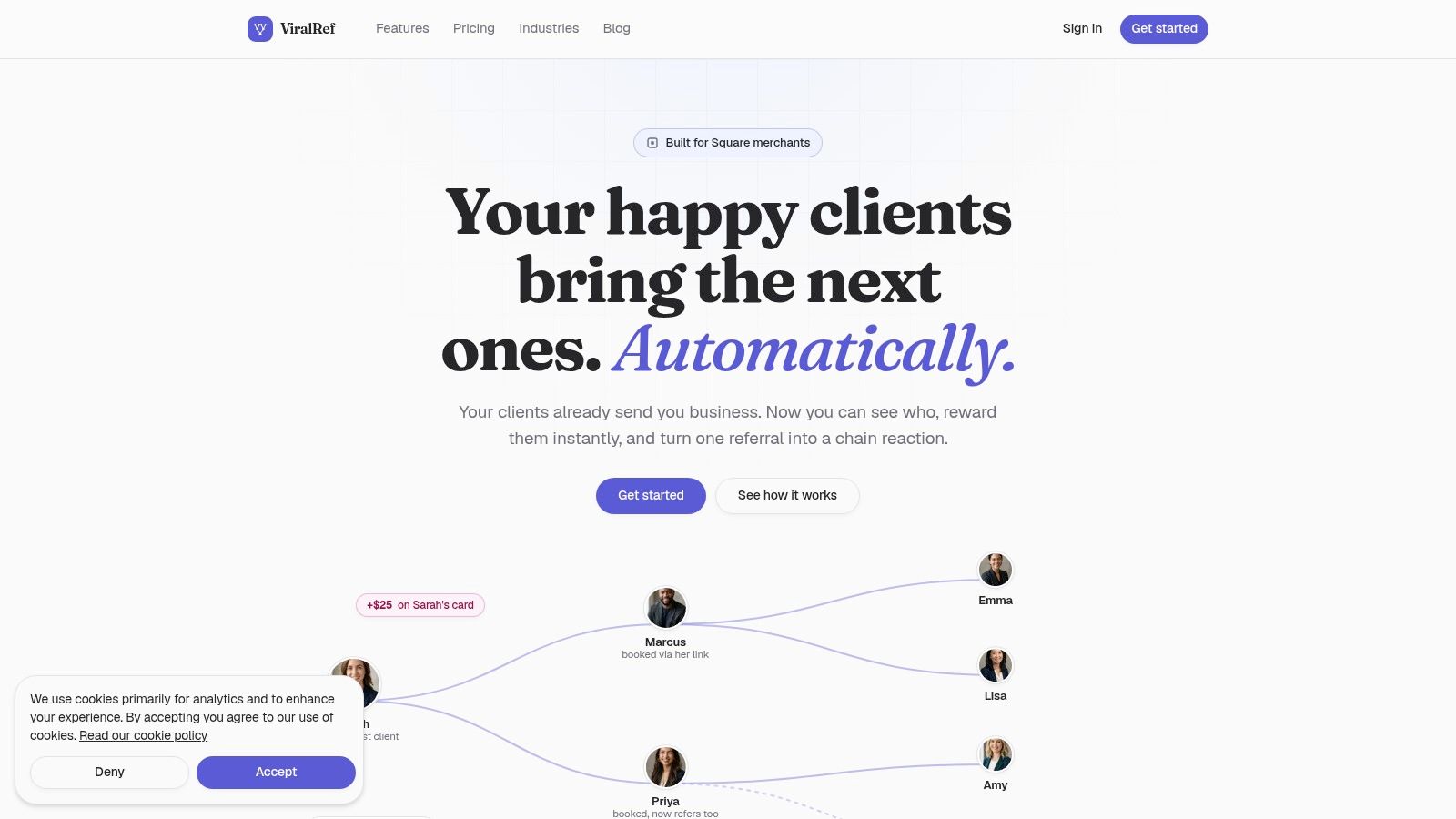
A referral program gives you a way to reward growth without paying for a customer's opinion. ViralRef is the only referral program built natively for Square, and it connects the reward to a measurable event, such as a referred customer booking and completing payment.
For a salon, a regular client can share a personal referral link or QR code with a colleague. For a barbershop, the link can appear in a client portal that the customer accesses by phone number, without downloading an app. For a fitness studio, a member can share the offer with a friend, who receives a first-visit benefit while the referring member receives the promised reward after the qualifying purchase.
Connect the program to your existing workflow
The setup can fit around tools you already use:
- Square POS: Apply referral rewards at checkout when the qualifying purchase is attributed.
- Square Appointments: Connect a new booking to the referring client and track whether the appointment becomes a paid visit.
- Square Loyalty: Keep loyalty activity distinct from referral rewards, while using both to encourage retention.
- Square Invoices and Virtual Terminal: Apply eligible coupons or rewards across supported payment workflows.
The important design choice is the trigger. The reward isn't released because someone posted a review. It becomes available because a new customer arrived through the referral and completed the required transaction. That creates a clear connection between the reward and new business.
ViralRef can issue in-house gift cards or auto-applying coupons, and it can support referral roles for clients, staff, and influencers. Its referral tracking can attribute payments, calculate commissions, and flag activity such as self-referrals, duplicate conversions, rapid conversions, and disposable email addresses for review.
Build word of mouth without review pressure
A practical campaign might work like this:
- Connect your Square account and define the qualifying booking or purchase.
- Give each participating client a personal link and QR code.
- Offer the referred customer a clearly described first-visit benefit.
- Release the referrer's reward only after the new customer completes payment.
- Ask both customers for honest feedback separately, without making the referral reward depend on a review.
This approach still gives happy customers a reason to talk about your business. It rewards an action you can verify, bringing a new client into the salon, studio, spa, or barbershop.
For operational ideas such as automated attribution, reward rules, and campaign controls, see how to automate your referral program with ViralRef.
Best Practices for Service Businesses
The safest reputation strategy combines two systems that do different jobs. Review requests collect honest customer experiences. Referral programs encourage customers to introduce people they know. Problems start when one system is used to manipulate the other.
A salon owner can send the same review request after every appointment, whether the client booked with Square Appointments or paid through Square POS. The owner can then invite satisfied clients to share a referral link, but shouldn't offer a reward for posting a particular review or rating.
Replace risky habits with clear actions
| Risky habit | Safer operating habit |
|---|---|
| “Leave five stars and receive a discount.” | Ask for honest feedback without attaching a reward. |
| “Change your review and we'll comp your next visit.” | Resolve the complaint and let the customer decide whether to update the review. |
| Send only happy customers to Google. | Give every customer the same review opportunity. |
| Reward a client for posting on Google. | Reward a client after a referred customer books and pays. |
| Ask staff to pressure customers at checkout. | Use a polite post-appointment request that customers can ignore. |
A direct, neutral request can be simple: “If you have a moment, please share an honest account of your visit.” Don't provide suggested praise, a required star rating, or language that asks customers to mention a specific employee.
When a review is negative, respond with accountability. Thank the customer for raising the issue, acknowledge what you can, and invite them to continue the conversation privately without asking them to remove or soften the public review.
For practical wording and timing ideas, use this guide on how to ask for a review. Keep the request separate from any referral offer so the customer understands exactly what each action means.
A checklist for your Square business
- Audit your offers: Remove discounts, free services, gift cards, or credits tied to posting, changing, or removing a review.
- Check your wording: Replace “five-star review” with “honest feedback.”
- Use one review path: Don't filter customers based on whether they appear satisfied.
- Connect your Square tools: Make sure bookings and payments can identify qualifying referral activity.
- Create shareable links: Give clients and staff easy referral links or QR codes.
- Define the trigger: Release rewards after the referred customer completes the required booking or payment.
- Review campaign activity: Watch for duplicate accounts, self-referrals, and unusual conversions.
- Respond consistently: Treat positive and negative feedback as part of the same customer experience process.
The strongest word-of-mouth programs don't need to manufacture enthusiasm. They make it easy for a satisfied client to recommend your business, then thank that client when the recommendation brings someone new through the door.
ViralRef gives Square merchants a structured way to issue referral links, track qualifying bookings and payments, and reward clients for bringing in new customers instead of rewarding review sentiment. Visit ViralRef to connect your Square workflow and start building a compliant referral program for your salon, barbershop, spa, or fitness studio.
Related articles
What Is a Gift Card and How Square Merchants Can Use One
What Is a Gift Card. Learn what a gift card is, how closed-loop and digital gift cards work for Square merchants, and how to turn them into a referral reward
Online Review Management for Square Merchants
Master online review management. Our guide for Square merchants helps you get 5-star reviews, handle feedback, & grow your client base.
How Does a Referral Work for Square Merchants
Learn how does a referral work for your service business. See the full mechanics of tracking, attribution, rewards, and fraud detection built