Referral Program Marketing: A Square Salon Growth Guide
Learn referral program marketing for Square salons to fill your calendar with loyal clients. Boost bookings with this simple strategy.
A client leaves your salon chair smiling, checks her new color in the mirror, and says, “I'm going to send my friend here.” You thank her, clean the station, and move on to the next appointment. A week later, nobody has booked. The client may still love your work, but her good intention has disappeared into a busy group chat, a forgotten text, or a day filled with errands.
That's the gap referral program marketing fills. It gives happy clients an easy way to share, gives their friends a clear reason to book, and gives you a reliable way to connect the referral to a completed Square payment. For a salon, barbershop, spa, or fitness studio, the point isn't to make customers “sell” your business. It's to make a natural recommendation easier to act on.
Table of Contents
- Introduction Why Word of Mouth Needs a System
- What Referral Program Marketing Really Means
- Why Referrals Outperform Ads for Service Businesses
- Key Building Blocks of a High Converting Program
- How Automated Tracking and Attribution Works on Square
- Real Examples and Use Cases for Salons Spas and Studios
- Launch Checklist Troubleshooting and Next Steps
Introduction Why Word of Mouth Needs a System
Word of mouth already happens in service businesses. A client talks about a great haircut while having coffee. A member mentions your fitness class at work. A spa guest recommends your massage therapist to a friend who's been looking for one. You've probably received new customers this way without knowing exactly who sent them.
The problem is that informal referrals are difficult to capture. You may hear, “My sister told me about you,” at checkout, but there's no consistent record of the source, no automatic thank-you for the existing client, and no clear way to tell whether referrals from hair color convert better than referrals from styling services.
A referral program turns that loose conversation into a simple customer journey:
- A happy customer receives a personal sharing link or QR code.
- Their friend uses it to learn about your salon, spa, or studio.
- The friend completes a qualifying purchase through Square.
- The original customer receives the reward you chose.
That structure matters because recommendations carry unusual weight. Nielsen-referenced research reports that 92% of consumers trust recommendations from friends and family above all other advertising formats, while 77% are more likely to buy a new product when someone they know recommends it. The figures come from the Nielsen-referenced referral marketing research, but the practical lesson is simple: your clients' personal experience can do work that a polished ad often can't.
Practical rule: Ask for a referral while the client is still feeling good about the service, then make sharing take less effort than remembering to share later.
This guide focuses on the details that matter in a busy Square business, including rewards, payment verification, staff participation, attribution, and fraud review. If you want more background on the difference between spontaneous recommendations and a structured process, read this explanation of what word-of-mouth marketing means. For the creative side of making messages easy to pass along, this shareable content psychology guide offers useful context.
ViralRef is built natively for Square, so the referral process can connect with the payment workflows you already use instead of forcing you to manage a separate spreadsheet. The result is a system designed to help fill calendars, encourage return visits, and show which relationships are producing real bookings.
What Referral Program Marketing Really Means
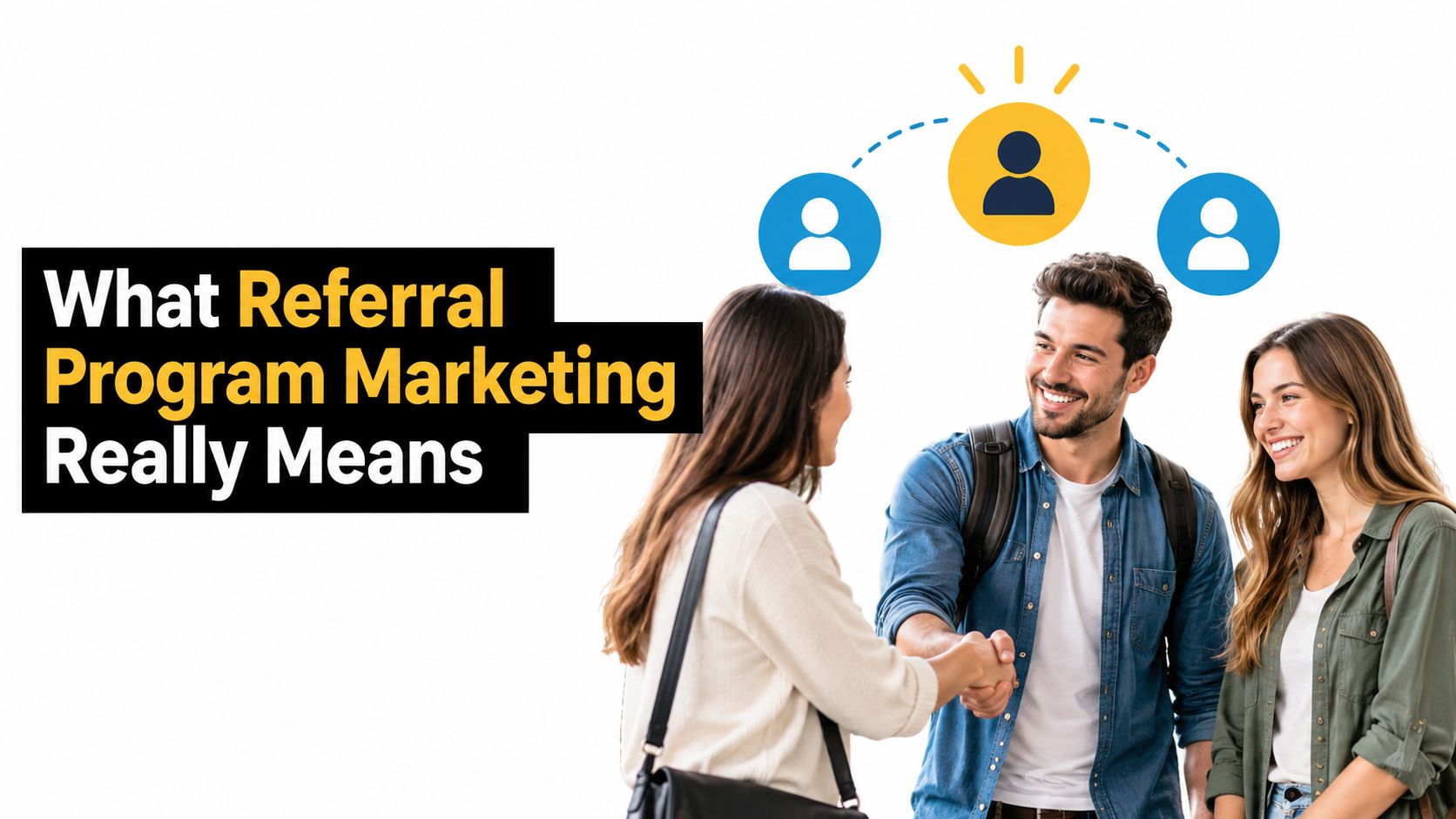
Start with the everyday version. A customer tells a friend, “You should try this salon.” That's word of mouth. It becomes referral program marketing when you add a clear invitation, a reward, and a way to recognize what happened after the friend visits.
Think of the program as a thank-you card that tracks itself. Your regular client gets a personal card with their name on it. They can hand it to a friend, send it by text, or let the friend scan a QR code. When that friend books and pays, the system knows which customer made the introduction and can issue the thank-you automatically.
The people and actions involved
A few plain-language terms keep the program easy to understand:
- Referrer: The current client who recommends your business.
- Referred friend: The new customer who receives the invitation.
- Double-sided reward: A benefit for both people, such as a first-visit offer for the friend and a gift card for the referrer.
- Attribution: The record showing which referrer led to the new customer's qualifying purchase.
- Qualifying payment: The completed transaction that makes the reward eligible.
That last term is especially important for Square merchants. A click isn't a customer. A shared code isn't revenue. A reward should be tied to a completed, verified payment through Square POS, Square Appointments, invoices, or Virtual Terminal. This protects your margins and keeps the program aligned with actual service activity.
Referral marketing is not the same as loyalty
Square Loyalty generally rewards a customer for their own repeat purchases. A referral program rewards a customer for introducing someone new. You can use both, but they solve different problems.
An affiliate relationship is also different. Affiliates, staff members, or local influencers may promote your business regularly and earn a commission under agreed rules. A customer referral program usually starts with a personal recommendation from someone who already visits you. Some businesses use both approaches, assigning different links, rewards, or groups to each role. If you're exploring structured partner relationships beyond customer referrals, you can join the partner program from Trendy as a separate channel.
The best starting point is a sentence anyone on your team can repeat: “Your friend gets a welcome offer, and you receive a thank-you after their first completed payment.” If a receptionist, stylist, trainer, or client can understand the offer immediately, your program has a strong foundation.
Why Referrals Outperform Ads for Service Businesses
A paid ad introduces your business to a stranger. A referral introduces you through someone the prospect already trusts. That distinction is powerful in services because the buyer isn't only choosing a product. They're choosing a person, a place, and an experience they hope will go well.
A new salon client may worry about a bad color result. A first-time spa guest may feel uncertain about the treatment or therapist. A fitness prospect may wonder whether the class will be welcoming. A personal recommendation answers some of those concerns before your front desk ever speaks with the prospect.
The evidence supports the trust advantage. Nielsen-referenced findings say people are 4 times more likely to buy when referred by a friend, and the supporting source connects that behavior to the growth of referral programs in both consumer and B2B marketing. You can compare that warm introduction with the colder path described in advertising in e-commerce, where a business must earn attention before it earns confidence.
Conversion is only the first test
A referral program shouldn't be judged only by how many people click a link. Service businesses need to know whether referred clients return, choose additional services, and remain a good fit for the team's schedule.
Industry roundups cite an average referral conversion rate of around 8.2%, compared with roughly 1.8% to 2.5% for standard web traffic, while other summaries place referral and affiliate e-commerce conversion between 4% and 5.4%. Those benchmarks come from referral marketing statistics collected by Review42, and they aren't a promise for your salon or studio. They do show why referral traffic deserves separate measurement rather than being mixed into general website traffic.
The stronger business case is customer quality. A Journal of Marketing study involving about 10,000 bank customers found that referred customers had at least 16% higher lifetime value than comparable non-referred customers, according to the same Review42 summary. Another account of the field research reports higher contribution margins and retention among referred customers, with the retention advantage persisting over time. For a service business, that can mean a fuller rebooking calendar, fewer empty appointment slots, and less dependence on constantly finding new strangers.
The referrer can become more loyal too
Referral participation may also deepen the relationship with the client who sends the introduction. In a field experiment at a global telecommunications provider, recommenders' defection rates fell from 19% to 7% within one year, and their average monthly revenue increased by 11.4% compared with a matched control group, as reported by Rivo's referral program research summary.
Your salon or studio shouldn't assume it will reproduce those results. The useful principle is that inviting someone into a community can reinforce the referrer's connection to your business. A client who proudly recommends your stylist, trainer, or treatment may have another reason to keep returning.
Key Building Blocks of a High Converting Program
A referral program has several choices, but you don't need to make them complicated. Start with the customer experience, then make the reward and tracking rules fit the way your Square business already takes payment.
Choose a reward that supports the next visit
Gift cards keep value inside your business. A client who earns an in-house gift card has a natural reason to book again, try another service, or bring the reward into a future visit. For a salon, that could support a return appointment. For a fitness studio, it could encourage another class or a guest visit.
Auto-applying coupons can be more useful when the main goal is reducing hesitation for a first appointment. A referred friend may see the offer at Square POS, Virtual Terminal, or on an invoice, depending on how you complete the sale. The friend receives a clear welcome benefit, while you keep the offer connected to a real transaction.
A double-sided reward often makes the message easier to share. The client can say, “You'll get something on your first visit, and I'll receive a thank-you after you pay.” That feels more generous than asking a customer to promote your business only for your benefit.
Match the program to the job
| Reward Type | Best For | How It Works at Square | When to Use It |
|---|---|---|---|
| In-house gift card | Encouraging return visits | Issue the reward after a verified qualifying payment | Use when repeat bookings and retained revenue matter most |
| Auto-applying coupon | Removing first-visit hesitation | Apply the offer through Square POS, Virtual Terminal, or Invoices | Use when prospects need a simple reason to try you |
| Staff commission | Recognizing team-driven referrals | Give each staff member a personal link and track qualifying purchases | Use when stylists, trainers, or receptionists actively introduce clients |
| Influencer reward | Local awareness and community reach | Assign a partner link with agreed commission rules | Use when a trusted local voice reaches your ideal customers |
| Bounty or challenge | Filling slow periods | Add a time-specific incentive to selected groups or services | Use when certain classes, days, or appointment blocks need attention |
For a fuller look at these options, see the complete guide to referral reward types.
Give staff and partners clear boundaries
A stylist shouldn't have to guess whether a referral counts. Explain which services qualify, when the reward becomes available, and what happens if a customer cancels or receives a refund. Staff links and influencer links should also be separate from ordinary client links so you can compare their activity fairly.
ViralRef can support flexible rewards, staff and influencer groups, tiered rates, bounties, challenges, and built-in fraud screens for self-referrals and disposable emails. Its fraud process flags suspicious activity for review rather than automatically rejecting every unusual referral. That matters when a legitimate client shares a link from a new device or a family member pays in person.
How Automated Tracking and Attribution Works on Square
Automation should make the process feel invisible to the owner and clear to the customer. After a quick Square connection, each customer can receive a unique referral link and a branded portal that they access with a phone number, without downloading an app.
The basic flow looks like this:
- The customer receives an invitation. You can share it by text, through a social post, on a receipt insert, or from a front-desk QR code.
- The customer shares the invitation. Their friend taps the link or scans the code and sees the offer connected to your business.
- The friend books or contacts you. The referral remains associated with the customer who made the introduction.
- The friend pays through Square. The qualifying transaction may happen through Square POS, Square Appointments, an invoice, or Virtual Terminal.
- The system verifies the payment. It then attributes the purchase, calculates any commission, and tops up a gift card in real time when that's the chosen reward.
Why payment verification protects the program
If you reward every click, people can create activity without creating business. If you reward every code share, you may pay for referrals that never arrive. Requiring a completed qualifying payment gives you a clean rule that staff and customers can understand.
Offline service purchases make attribution especially important. A client may discover you through a link, book by phone, and pay at the front desk. A last-click report may miss the relationship, while a Square-connected referral record can connect the introduction to the verified payment.
Your reports should answer more than “How many referrals did we get?” Look for referral quality, revenue attribution, conversion rates, and retention by service type, location, staff member, or partner group. A stylist may produce fewer referrals but bring clients who rebook. A trainer may fill more off-peak classes. Those differences affect how you set rewards.
For broader measurement ideas, track sales attribution with ViewsMax provides a useful perspective on connecting activity with revenue. You can also review master referral program tracking for a more detailed approach to defining referral events and outcomes.
Real Examples and Use Cases for Salons Spas and Studios
A referral program becomes easier to operate when it fits a moment your team already recognizes. The best prompt usually follows a positive interaction, not a random request sent to every customer.
A salon turns the finished color into an invitation
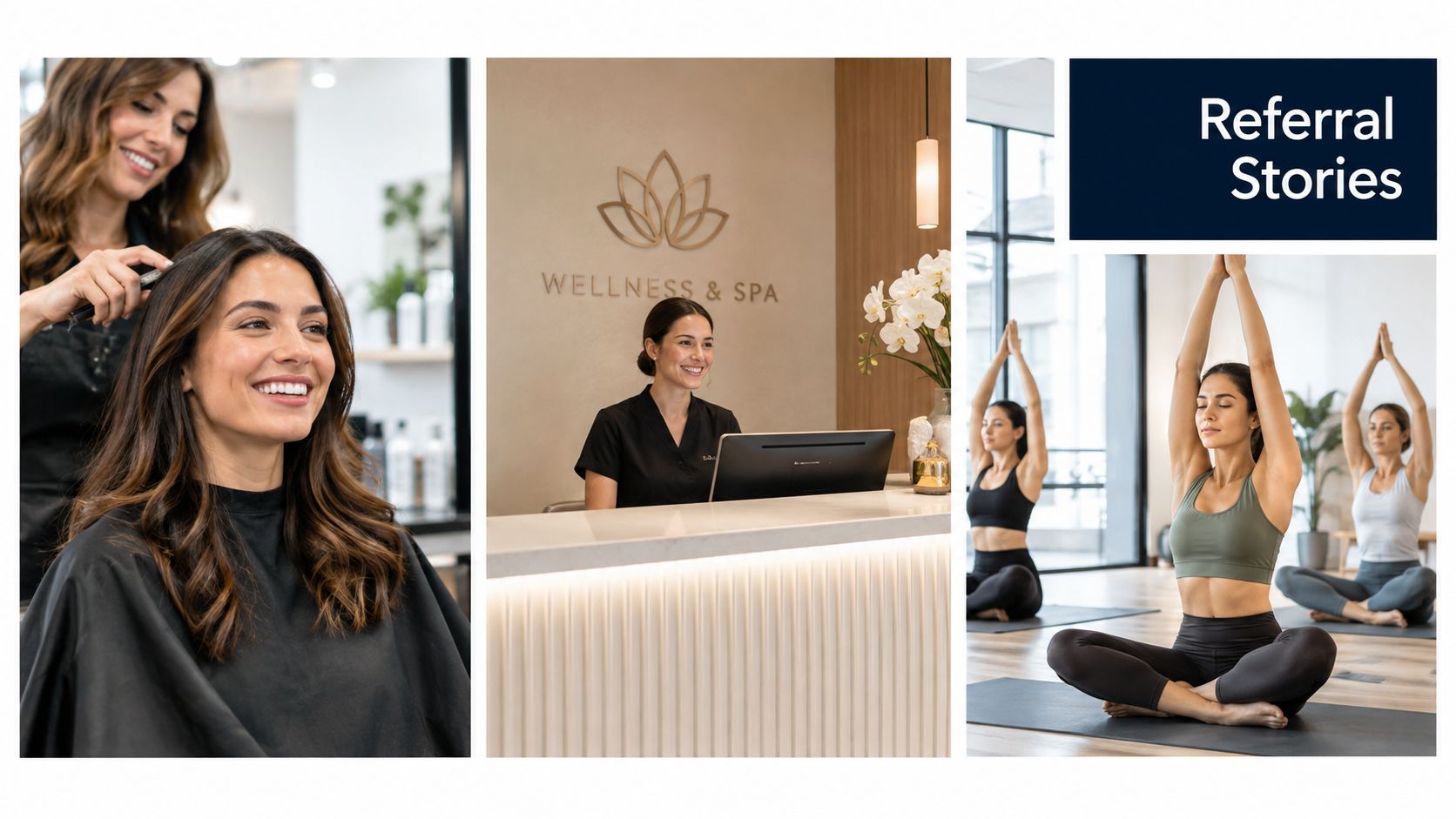
A client checks her color under the salon lights and tells the stylist she loves it. The stylist sends her to the branded referral portal before she leaves, or the client scans a small QR code at checkout. The message focuses on the friend: “Send this to someone who's been looking for a colorist.” The existing client receives a reward only after the friend completes a qualifying Square payment.
The salon can compare referrals connected to color, cuts, and styling without relying on memory. It can also see whether those new clients return for another appointment, which is more useful than counting names on a paper card.
A spa connects referrals with membership habits
A spa manager introduces the program during a membership conversation. The member receives a personal link and shares it with a friend who has been asking about regular treatments. The friend gets a first-visit offer, while the member earns an in-house reward after the completed payment.
The spa can use a challenge when a normally quiet appointment period needs more attention. Rather than discounting every service, the manager can focus the incentive on selected treatments or times, then review whether those referred guests return.
A fitness studio gives staff and local partners their own paths
A studio gives each instructor a personal link, QR code, and dashboard. An instructor mentions the link after a welcoming class, while a local wellness creator shares a separate partner link with their audience. Groups and tiered rates keep customer, staff, and influencer activity distinct, which helps the owner understand who is bringing in members who fit the studio.
The same approach can support a short challenge for off-peak classes. The owner can measure bookings, repeat visits, and revenue from each group instead of treating every referral as equal. For more ideas across different business situations, review these referral program examples.
Launch Checklist Troubleshooting and Next Steps
Keep the first launch simple enough for your team to explain between appointments.
- Connect Square: Link the program to the Square payment workflows you use.
- Set the reward rule: Decide whether the customer, the friend, or both receive a benefit, and require a completed qualifying payment.
- Brand the portal: Use your salon, spa, barbershop, or studio name so the invitation feels familiar.
- Onboard staff: Give stylists, trainers, receptionists, or instructors clear links and a short explanation.
- Promote at the right moment: Place the prompt after a successful service, inside post-purchase communication, and in the customer dashboard.
- Review quality: Compare referral conversion, revenue attribution, retention, and referrer activity by service and location.
Weak promotion is a common reason programs stay quiet. A reward that benefits only the referrer can also feel awkward to share, especially when the friend receives nothing. Offline visits create another challenge, so don't assume last-click reporting tells the whole story.
Fraud screens should help you investigate, not punish legitimate customers. Watch for self-referrals, duplicate activity, rapid conversions, disposable emails, VPN or device spoofing, and automated claims. At the same time, review flagged referrals before rejecting them, because a real family member may share a device or pay in person.
FAQ: How do I measure downstream quality? Track the first completed payment, then compare return visits, revenue, and retention by service type, location, staff member, or partner group.
FAQ: What should I do when a legitimate referral is flagged? Review the customer record and Square payment manually, confirm that the transaction qualifies, and approve the reward when the referral reflects a genuine new customer.
ViralRef gives Square merchants unique referral links, branded customer portals, QR and social sharing, flexible gift card or coupon rewards, staff and influencer groups, challenges, payment-based attribution, and fraud flags for review. Visit ViralRef to connect referral program marketing with the Square POS or Appointments workflow you already use, then give one happy client an easy way to bring in the next one.
Related articles
Referral Program Examples for Salon & Spa Growth
Steal 10 referral program examples from top brands. Adapt them for your salon, spa, or studio using Square & automated tools to get new clients.
Customer Referral Program Guide for Square Merchants
Turn happy clients into your best marketing. Our guide for Square merchants covers setting up a customer referral program that fills your schedule.
Referral Marketing Platform Guide for Square Merchants
Learn what a referral marketing platform does, key features, ROI and how Square salons and studios turn word-of-mouth into bookings.