Business Referral Program Guide for Square Merchants
Learn how a business referral program works on Square. Plain-English guide for salons, spas, and studios covering rewards, attribution, and fraud control.
You've probably seen the pattern. Saturday is packed, your regulars are happy, and someone mentions that a friend came in because a client recommended you. Then Tuesday arrives, the chairs are empty, and you realize you have no idea how many new customers came from those conversations.
Word-of-mouth is already working for your salon, barbershop, spa, or studio. A business referral program gives that word-of-mouth a clear path, a fair reward, and enough tracking to show whether it's creating profitable repeat business. For Square merchants, the opportunity is especially practical because your customer, appointment, and payment activity already lives in one operating system.
Table of Contents
- What a Business Referral Program Actually Is
- How Referral Attribution Works on Square
- Gift Cards vs Coupons for Referral Rewards
- Fraud Controls That Protect Your Program
- Analytics That Matter Beyond Share Counts
- Scaling With Staff, Clients, and Influencers
- Launching and Growing Your Referral Program
What a Business Referral Program Actually Is
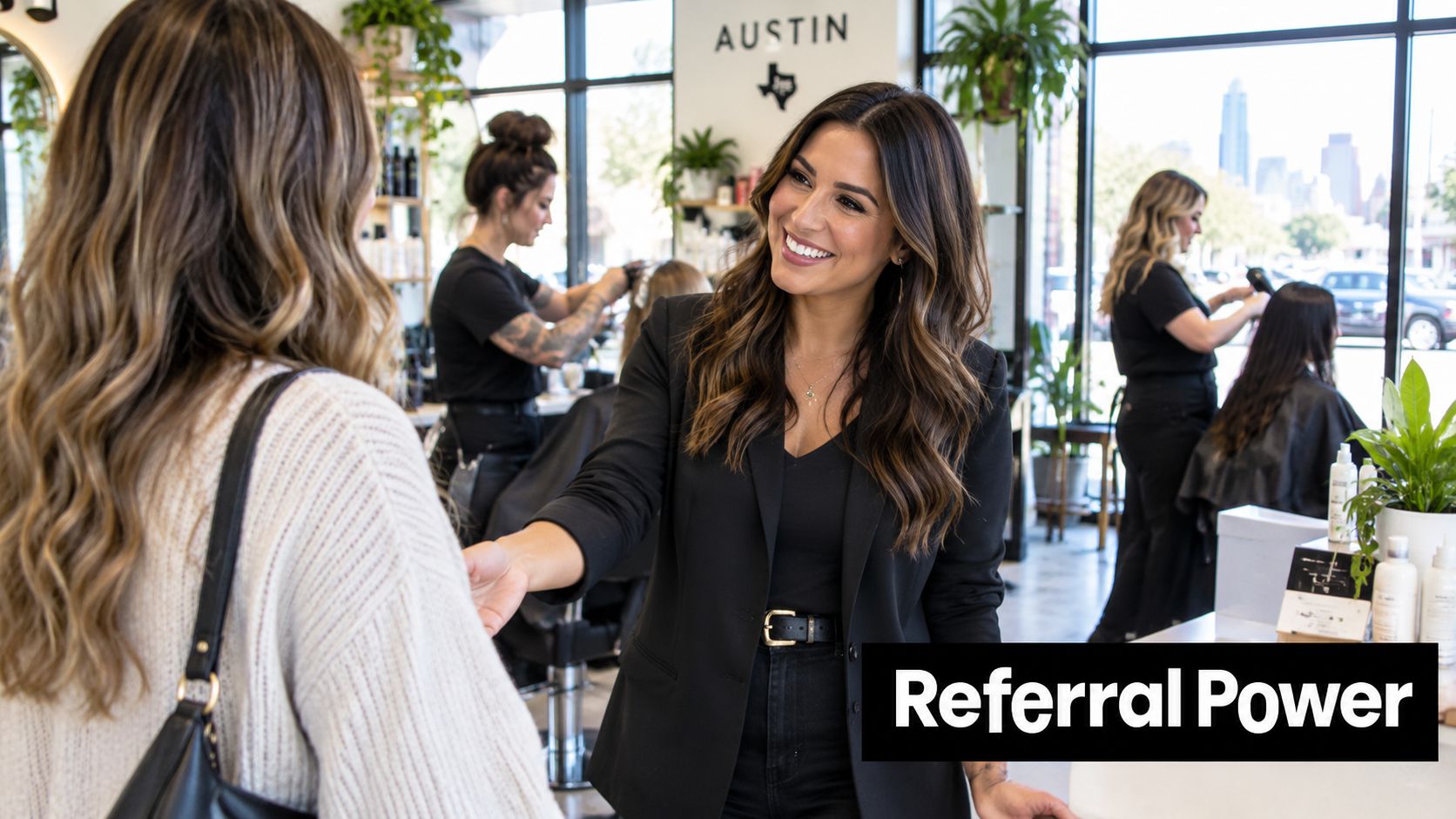
Maria owns a salon in Austin. Her Saturday appointments fill quickly, while Tuesday still has open chairs. A new client may say a friend recommended the salon at brunch or in a group chat, yet Maria has no reliable way to identify that referral, connect it to a visit, or decide when a thank-you is due.
That gap is where a business referral program earns its place. It gives an existing customer a clear way to recommend the business, records which new customer came through that recommendation, and issues a reward after a defined outcome. The outcome might be a first paid appointment, completed class, or completed service.
The basic parts
A workable program needs four parts:
- A clear advocate: The current client who recommends your salon, class, treatment, or studio.
- A simple share method: A personal link, code, or QR code that a client can use from a phone.
- A qualifying action: The event that makes the referral valid, usually a first paid appointment or completed service.
- A worthwhile reward: A gift card, account credit, or coupon that fits your margins and gives the advocate a reason to share.
A generic discount code handles only the price. It does not identify the referring customer or show whether the offer created a new booking. A referral link connects one person to one new customer and one completed outcome, giving the business a clearer basis for rewards and reporting.
Square merchants already have much of the operating information a referral program needs. Square POS records payments, Square Appointments records bookings, and customer profiles contain transaction history and contact details. Square Loyalty can award points based on visit frequency, spending, item variation, or category, but it does not provide referral attribution, as shown in this comparison of Square Loyalty. A Square-native referral tool such as ViralRef can connect the recommendation to the customer and paid visit, then automate the program without spreadsheets.
The distinction matters for salons, barbershops, spas, and studios. A prospective client often trusts a personal recommendation before trying a new barber, esthetician, massage therapist, or fitness class. For a broader explanation of referral program structure, this guide to referral programs for SaaS offers useful fundamentals, though service businesses must adapt them to appointments and repeat visits.
The practical definition is direct: a business referral program rewards a current customer when their recommendation produces a real new customer. Set the sharing method, qualifying action, and reward in plain language. Use the completed Square payment to determine when the reward becomes valid. This plain-English explanation of referral programs can help clarify the model before you choose your rules.
How Referral Attribution Works on Square
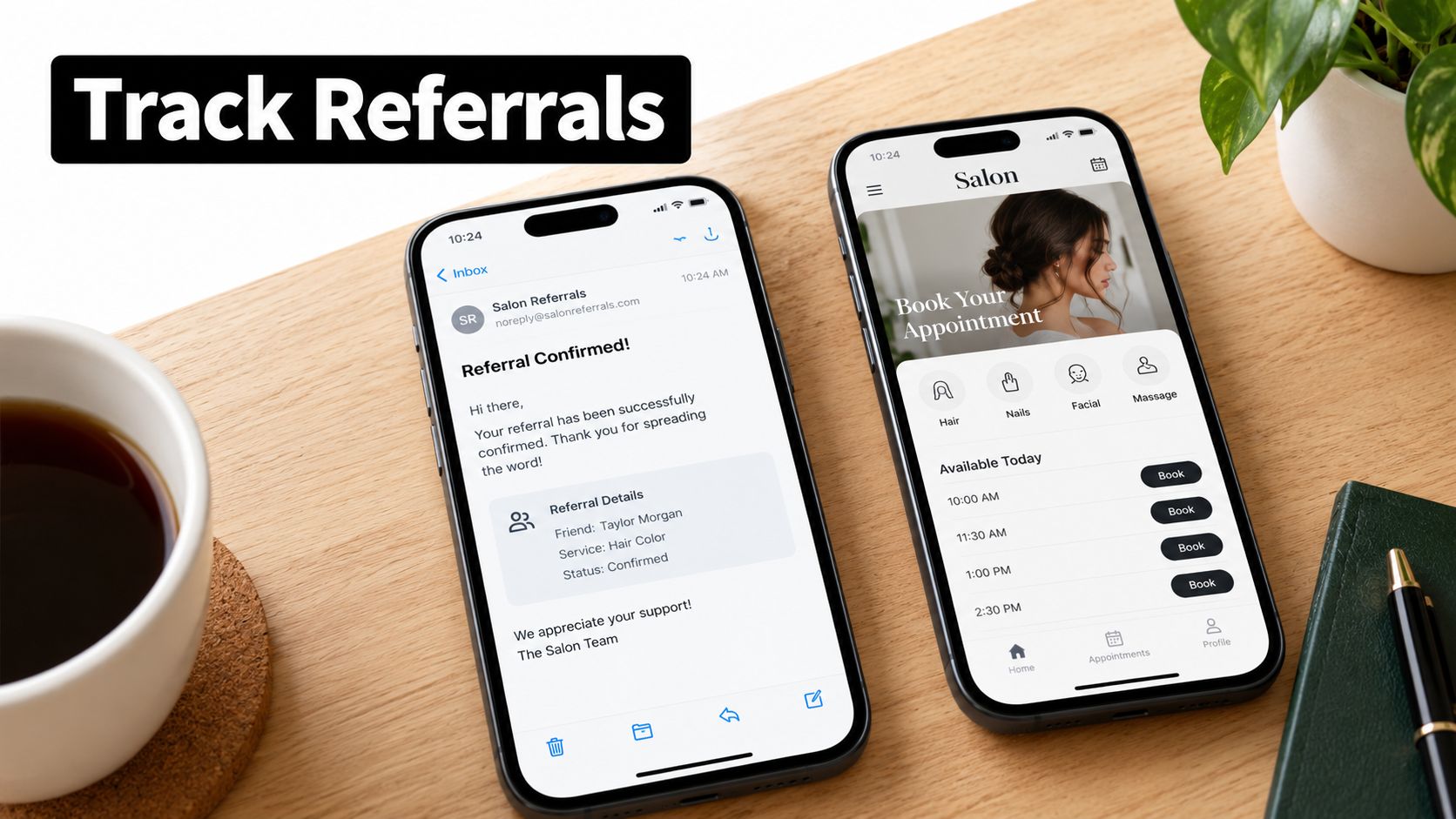
Square merchants already have the records needed to measure a referral: customer profiles, appointments, and completed payments. Attribution connects those records so a salon can follow one recommendation from the first click to a paid visit, without asking staff to reconcile reports manually.
Jen finishes an appointment and receives a follow-up message with her personal referral link. She shares it with her sister Sam, who uses the link to book through Square Appointments. The referral becomes meaningful when Sam attends, receives the service, and pays through Square, not when she clicks or creates a booking.
Four points in the chain
- Share: Jen's personal link identifies her as the referrer. The system records the click and carries the referral information into Sam's session or customer record.
- Booking: Sam follows the link and books through Square Appointments. Her appointment stays connected to Jen's referral source.
- Payment: Sam arrives, receives the haircut, and pays through Square POS. That payment confirms a completed transaction.
- Reward credit: The program checks its rules and credits Jen with the promised reward. A cancellation, no-show, or refund can leave the reward pending or reverse it, depending on the terms.
A Square-native referral tool such as ViralRef can use the available Square connections to match the appointment with the payment. It can check whether Sam is a new customer, whether the service meets the qualifying conditions, and whether the transaction was later refunded. Staff do not need to compare booking reports with a spreadsheet of names.
Rules to settle before launch
Set the attribution window before customers begin sharing. It defines how long a referral remains associated with a person after the click. Decide whether the qualifying event is a new booking, an attended appointment, or a cleared payment. For salons, barbershops, spas, and studios, a completed paid visit usually gives the clearest basis for issuing a reward.
Write the refund rule at the same time. If Sam pays, Jen receives credit, and Sam later receives a full refund, the program should mark the reward for review or reverse it. Define how no-shows, rescheduled appointments, partial payments, and multiple referral links are handled as well.
The difference between a click and a completed outcome is the foundation of marketing attribution. Share counts show interest. A completed Square payment gives the business a defensible point for awarding the reward and measuring which customers create revenue.
Gift Cards vs Coupons for Referral Rewards
A new client books a first appointment after a friend shares a referral link. The new client wants an immediate reason to try your business, while the existing client needs a reason to return. One reward rarely handles both jobs well. Choose the incentive based on the behavior you want to create.
| Factor | Gift Card Reward | Coupon Reward |
|---|---|---|
| Best use | Thanking the referrer and encouraging a return visit | Reducing the barrier for a new customer |
| How value works | Stored value redeemed with your business | Discount applied to a qualifying transaction |
| Effect on first visit | Usually does not reduce the new customer's first-service price | Can reduce first-visit revenue and margin |
| Retention potential | Encourages the recipient to return and use the balance | May end after the first discounted visit |
| Operational fit | Useful for repeat services, packages, and add-ons | Useful for trials, introductory appointments, and new classes |
| Main risk | Unused balances and poorly controlled redemption rules | Discounting customers who would have paid full price |
A gift card keeps the reward inside your business. A $20 credit, for example, can apply to a later haircut, facial, massage, or class. The recipient may spend more than the balance during that visit, and the credit gives staff a clear reason to invite the client back. Treat the reward as a real future service cost, not free money. Set an expiration policy, eligible services, and redemption rules before launch.
Coupons work at the acquisition stage. “Your first class is discounted” gives a prospective customer a clear reason to book. The trade-off is immediate margin loss, even though you do not yet know whether the customer will return. A coupon also needs limits, such as one use per new customer and a defined qualifying service, so regulars do not receive discounts intended for first-time visits.
A practical two-sided structure
Many Square merchants use both incentives:
- The referred customer receives a first-visit coupon that reduces trial friction.
- The existing customer receives an in-house gift card after the new customer completes and pays for the service.
Each reward has a separate job. The coupon supports acquisition. The gift card supports retention. Because Square already holds customer, booking, and payment activity in one operating system, a Square-native referral tool can connect the reward to the completed transaction instead of asking staff to track redemptions in spreadsheets. Gift card management software can also help manage stored value when the program grows.
A spa might offer a first-treatment coupon to a new guest and credit the referring client toward a future facial. A fitness studio could discount a trial class for the new member while giving the advocate credit toward a later class package. A barbershop might give the new client a fixed first-visit offer and the referrer a service credit.
Set the reward from your own numbers. Review the service's gross margin, the likelihood of repeat visits, and the value of acquiring a new customer. A reward that feels trivial will not motivate sharing. One that is too generous can make a busy program unprofitable. Start with a controlled offer, measure redeemed rewards and repeat visits, then adjust the structure rather than guessing at a larger incentive.
Fraud Controls That Protect Your Program
A referral program can lose money without notice when one person creates several accounts, uses burner email addresses, books a first-time service, claims the reward, and never returns. Other warning signs include the same device, payment method, or address appearing across customers who supposedly have no connection.
Square merchants can review signals such as:
| Fraud Signal | What It Looks Like | Program Response |
|---|---|---|
| Shared identity details | Multiple referrals use the same email pattern, phone number, payment method, or address | Flag the referrals and compare customer records before payout |
| Self-referral behavior | A customer sends a link to another account controlled by the same person | Hold the reward and review booking history |
| Rapid conversions | Many new accounts book or convert unusually quickly | Apply a temporary payout hold and inspect the activity |
| Repeated refunds | A new customer pays, earns a reward, then requests a refund | Reverse or pause the reward under the published terms |
| High-volume activity | One advocate generates an unusual number of first-time claims | Apply an earning cap or review each conversion |
| Duplicate accounts | Several profiles appear to represent the same customer | Merge or investigate the profiles before crediting rewards |
Square already brings customer, booking, and payment activity into one operating system. A Square-native tool such as ViralRef can compare the referral event with that existing record, helping staff separate a completed paid appointment from a cancellation, refund, or duplicate claim. A referral fraud detection system can organize those checks without forcing the team to maintain another spreadsheet.
Use suspicious signals to start a review, rather than treating one match as proof of abuse.
Practical rule: Hold questionable rewards for review instead of automatically blocking every unusual customer.
Legitimate edge cases are common. Family members may share an address. Roommates may use the same Wi-Fi. A front-desk employee may book an appointment for a client. Hard-blocking every match can penalize good customers and create arguments at checkout.
Set the controls before launch. Cap earnings per person or period, delay payout until the service is completed, and define the action after a refund. Record why each reward was approved, held, or denied, so staff can give customers the same answer.
For background on stopping automated abuse in web apps, apply the same operating principle here: combine several signals before taking action. The goal is accurate payouts and a clear human review for borderline cases.
Analytics That Matter Beyond Share Counts

A referral dashboard can show plenty of activity while the program loses money. One client may share a link repeatedly without producing a booking. Another may share once and bring in a customer who returns for months. Share counts measure attention, not business value.
For a service business, follow the full path from share to first visit to repeat visit to revenue. Track referral rate, referred-lead conversion, customer acquisition cost, and customer lifetime value separately, so booking volume does not hide unprofitable rewards. The referral measurement guidance from Extole explains why each stage needs its own measure.
Four numbers worth watching
- Referred customer lifetime value: Compare spending from referred customers over time with the reward and service costs required to acquire them.
- First-visit-to-repeat-visit rate: Measure how many referred customers book again. For a salon or studio, this can matter more than the initial booking total.
- Revenue per active referrer: Identify clients, staff members, or partners who generate completed paid visits, rather than link clicks alone.
- Acquisition cost by source: Compare rewards and other program expenses with the cost of acquiring customers through paid advertising.
Square already connects payment and customer activity in the merchant's operating system. A Square-native referral tool such as ViralRef can connect a referral to a completed POS transaction, then match later appointments and payments to the same customer. That gives you a practical basis for deciding whether to promote the program more, change the reward, or stop a source that attracts one-time bargain hunters.
A decision-making dashboard
A useful dashboard answers, “Which advocates produced profitable repeat customers?” Include the referral source, first paid service, reward issued, refund status, repeat visit, and revenue generated. A click total belongs in the report, but it should not lead the decision.
At month-end, give your bookkeeper a reward liability or payout export, completed referral revenue, refunds, and manual adjustments. Keep marketing metrics separate from accounting records, while ensuring the two can be reconciled.
The same discipline applies to local advocates as to creators. The source may be a loyal client, staff member, or partner, but the business still needs to connect activity with outcomes. For context, compare these measures with key metrics for creator campaigns. A referral reporting and analytics view should turn those records into decisions, not another graph to admire.
Scaling With Staff, Clients, and Influencers
At a two-location studio, referrals may begin with two stylists texting clients from their personal phones. One stylist sends her booking link and remembers who she introduced. As the business adds a front-desk employee, regular members, and a local fitness influencer, that memory-based process creates disputes over credit.
Square already holds the customer and payment activity staff need to run the program. A Square-native referral tool such as ViralRef can turn that existing setup into a measurable, automated process without spreadsheets. Give each advocate a unique link or printed QR code, then define the qualifying action and reward before anyone starts sharing.
Give each role a clear lane
Staff members need a reward structure that supports referrals without creating commission confusion. A 50/50 split between the employee and the referred client is a sensible starting point for the reward pool if it fits the studio's labor costs and margins. The employee has a reason to mention the offer, and the new client receives a benefit for trying the studio. Put the rule in writing so managers do not negotiate it at checkout.
Regular clients generally respond better to a modest ongoing credit than to a complicated one-time bonus. A yoga studio member could earn credit after each qualifying new-member conversion, subject to a cap. The front desk should be able to explain the offer in one sentence.
Influencers need written terms before they publish. Specify whether payment applies to a first visit, a first paid package, or another qualifying visit. Include the attribution window, refund treatment, and whether the influencer may promote the offer publicly. A large audience does not compensate for unclear terms or low-quality bookings.
Keep the customer experience simple. Place QR cards at reception, add a tap-to-share link to booking confirmations, and give staff a short sentence for checkout. Monthly leaderboards can recognize top advocates, provided they support the program rather than turning every interaction into a sales pitch.
For multiple locations, keep the reward rules consistent while giving each location access to its own results. Each advocate should be tied to the right person and location, so the business can protect staff rewards, prevent duplicate claims, and compare which channels produce completed appointments.
Scaling means adding clear participation paths, not every possible channel. Pay only after the referred customer completes the agreed action, and adjust a role's terms when its costs or customer quality no longer fit the business.
Launching and Growing Your Referral Program
A client leaves a salon after a great appointment and tells a friend. The opportunity is real, but without a clear offer and Square payment record, that recommendation is difficult to measure. Start small: choose one audience, one completed payment event, and one reward your team can explain in a sentence. Square merchants already have the customer, booking, and payment infrastructure. A referral tool can connect those records without adding a spreadsheet.
A practical launch checklist
- Choose one reward type. Start with a gift card or coupon. To test both sides, give the new customer a first-visit coupon and the referrer future credit. Keep eligibility and expiry conditions visible.
- Define the conversion event. Issue the reward after a completed, paid Square transaction, not after a click or an unconfirmed appointment.
- Create one short landing page. State who receives what, when the reward is issued, which services qualify, and how refunds affect eligibility.
- Add a QR code and personal link. Place the QR code at reception, in appointment follow-ups, and wherever a satisfied customer can easily share it.
- Tell existing clients directly. Ask after a successful service, include the offer in Square customer communications, and give staff one natural sentence to use at checkout.
During the first month, track completed referrals, reward cost, first-visit revenue, repeat bookings, and suspicious activity. A quiet week does not justify changing the offer immediately. Check whether clients noticed it, understood the terms, and had a simple way to share.
Once completed transactions provide enough evidence, change one variable at a time. Simplify the message, change the qualifying service, or replace a coupon with stored-value credit. Add a second reward tier only after staff can explain the first version clearly and the referral-to-revenue relationship remains steady.

Refresh the message periodically so regular clients continue to notice it. Train the front desk to mention the program after a positive interaction, rather than during a complaint or payment dispute. If you operate multiple locations, prove the process at one site before copying it elsewhere. A stable program has clear rules, dependable attribution, manageable fraud review, and rewards that encourage repeat visits.
ViralRef connects with Square to provide personal referral links, branded customer portals, QR sharing, payment-based attribution, gift cards and coupons, fraud review, and reporting for clients, staff, and influencers. Visit ViralRef to track word-of-mouth referrals and automate rewards without managing spreadsheets.
Related articles
Referral Management Software: A Guide for Square Merchants
Learn what referral management software does, which features matter for salons, spas, and studios on Square, and how to pick, launch, and measure a program that
Referral Program Meaning: A Guide for Square Merchants
Unpacking the referral program meaning for salon, spa, and studio owners. Learn how to turn word-of-mouth into new clients with automated rewards on Square.
Customer Referral Program Guide for Square Merchants
Turn happy clients into your best marketing. Our guide for Square merchants covers setting up a customer referral program that fills your schedule.