Gift Card Management Software for Square Merchants
Gift card management software explained for salons, spas, and studios on Square. Learn features, benefits, common pitfalls, and how to automate rewards.
If you run a salon, barbershop, spa, or studio on Square, you already know the feeling. Gift cards look simple until they start touching your calendar, your front desk, your staff rewards, and your books. Then they stop being a cute holiday add-on and become a real operating system for future visits.
That's why I take gift card management software seriously. For service businesses, it isn't just about selling a card. It's about filling dead spots in the schedule, keeping reward dollars inside the business, and making sure every card sold through Square turns into a booked service instead of a reconciliation mess. If you also want word-of-mouth to do more heavy lifting, that's where a referral layer matters. ViralRef is the only referral program built natively for Square, and that matters when you want gift cards to work as automatic rewards instead of manual thank-you notes.
Table of Contents
- The Slow Tuesday Problem Every Service Owner Knows
- What Gift Card Management Software Actually Does
- Features That Matter for Square Merchants
- Where Square Stops and Where You Need a Layer on Top
- How Referral Platforms Turn Gift Cards Into Automatic Rewards
- Choosing the Right Software for Your Business
- Common Pitfalls and How to Dodge Them
- Putting It All Together for Steady Bookings
The Slow Tuesday Problem Every Service Owner Knows
It's 11:40 a.m. on a Tuesday. Two chairs are empty. Lydia is pretending to tidy her station, but she's really refreshing Square Appointments to see if anything new sneaks in. The front desk phone is quiet. Nobody's buying retail. Nobody's checking out. You're open, staffed, and paying for the room anyway.
That's the leak.
Most service owners call this a marketing problem. I don't. It's a capacity problem. You already have the space, the payroll, the tools, and the appointment slots. The issue is getting future demand locked in before that slow block shows up on the calendar.
Gift cards do something ordinary promotions don't. They sell a future visit today. A client buys a card on Monday, sends it to her sister, and that sister often books when it works for her schedule, not yours. That's exactly why these cards can land in the middle of an otherwise soft week.
Why gift cards hit differently
A discount cuts your price right now. A gift card pulls cash forward and brings a person back later. Those are not the same thing.
For a salon or spa, that difference matters because service revenue depends on booked time. If your team has open spots, you don't need another branding exercise. You need a way to move tomorrow's demand into next week's empty chair.
A gift card is the only payment product most service owners sell that can turn idle time into prepaid demand.
If you're already spending on client acquisition, sharpen that first. This practical guide on Google Ads bidding for service businesses is worth reading because overpaying for clicks while ignoring prepaid return visits is backwards.
What changes when you manage gift cards well
The big shift is mental. Stop treating gift cards like a holiday side shelf item. Start treating them like a booking engine.
Owners who do this well usually use gift cards in three ways:
- Future booking fuel: Sell now, redeem later, and smooth out softer days.
- Client reactivation: Send cards to lapsed clients to restart the habit.
- Referral rewards: Thank the client who sends in a friend without leaking money out of the business.
That last one matters a lot on Square. When a reward lands as a gift card instead of cash, the client comes back into your chair, onto your table, or into your class schedule.
What Gift Card Management Software Actually Does
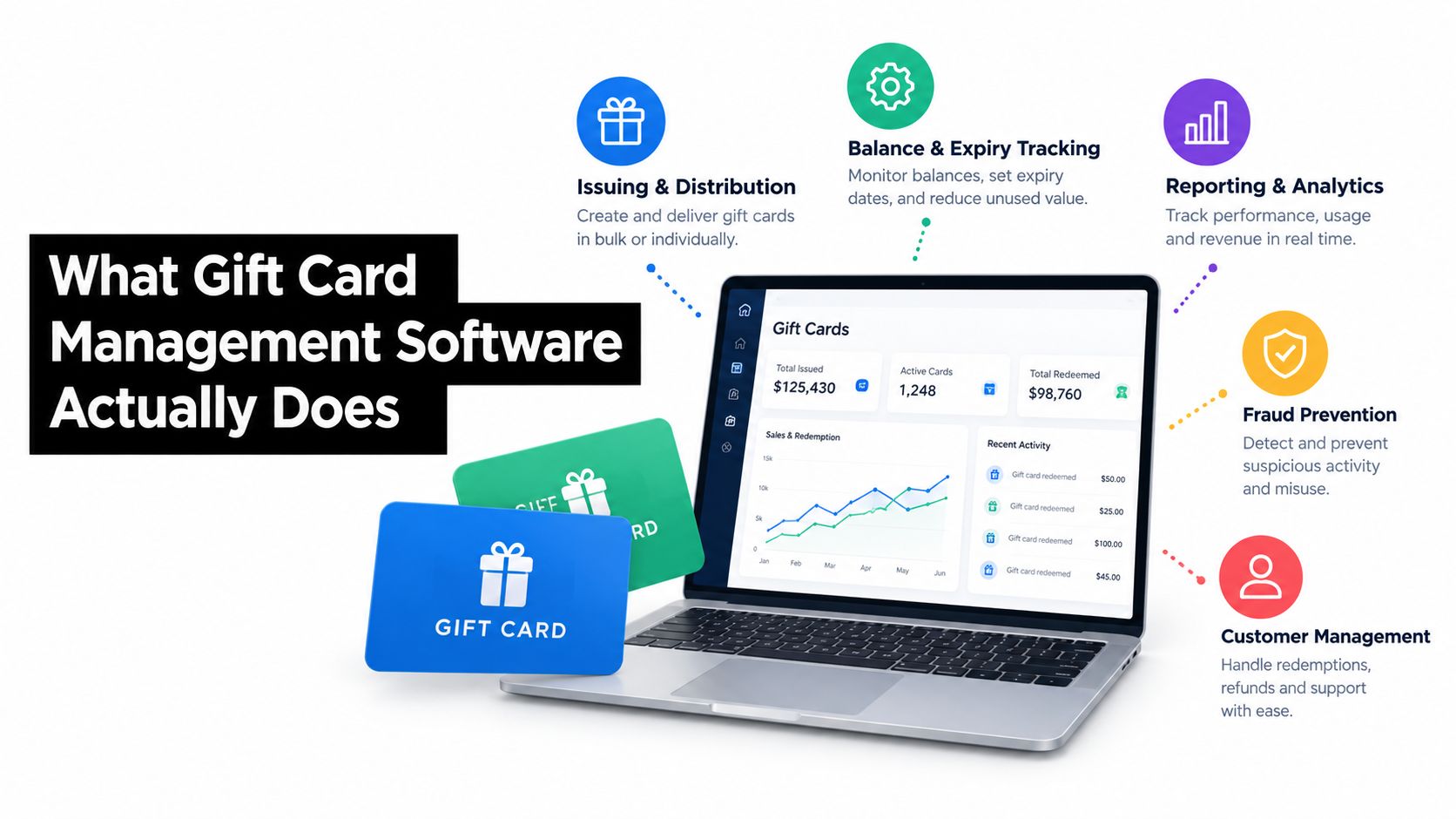
Think of your register this way. Square POS counts money coming in. Gift card management software counts visits coming in. It tracks value before the appointment happens, during redemption, and after the balance changes.
That's why I don't lump it into “admin software.” In a service business, this system affects sales, retention, staff incentives, fraud exposure, and client experience all at once.
The category is getting bigger because the market under it is getting bigger. One projection says the global gift card market will rise from US$825.3 billion in 2026 to US$2,220.6 billion by 2033, with a 15.2% CAGR, after historical growth of 12.5% CAGR from 2020 to 2025 according to Persistence Market Research on the gift card market. For small operators, the takeaway is simple. This is no longer a side feature.
The six jobs it must handle
Here's the plain-English test I use.
-
Issue cards where clients actually buy
In-store is obvious. Online matters just as much. Direct links matter more than most owners realize because that's how you text a last-minute gift option or include a reward in a campaign.
-
Track balances cleanly
Nobody at the front desk should be guessing what's left on a card. The system needs to show current value fast, especially during split payments or partial redemptions.
-
Reload existing cards
This gets overlooked. A good system lets a regular client keep one card and top it up over time instead of creating a fresh code every time.
-
Redeem at checkout without manual math
If your receptionist has to calculate leftovers on paper or open a second tool while checking out a haircut and product sale, the process is broken.
-
Catch suspicious activity
Fraud is part of gift cards now. Recent reporting says gift card scam losses hit $233 million in 2025, up from $212 million in 2024, and average loss per report nearly doubled versus 2021 according to Felix Day's gift card fraud statistics roundup. Even a small salon needs logs, freezes, and alerts.
-
Report sales, redemptions, and liability
Owners need to know what was sold, what was used, and what is still owed. If you can't see that quickly, month-end gets ugly.
Why this matters for Square shops
Square merchants often start with the right instinct but the wrong frame. They think, “I need gift cards.” What they usually mean is, “I need a cleaner way to bring clients back and track where those visits came from.”
That's where gift cards connect to referrals. If you want a plain-language breakdown of virtual gift cards and how they work in practice, read what virtual gift cards are. It helps if you've only ever thought in terms of plastic cards at the front desk.
Practical rule: If a gift card tool makes checkout harder for your front desk, it's not helping your business.
Features That Matter for Square Merchants
Most feature lists are written for giant retailers. That's useless if you run a salon suite, med spa, yoga studio, or barbershop on Square. You do not need enterprise junk you'll never touch. You need the features that keep checkout smooth, tracking clean, and bookings coming back.
Another market view puts the global gift card and incentive card market at US$626.11 billion in 2026 and projects US$930.23 billion by 2031 at an 8.24% CAGR. That same source also says digital gift cards reached a 50% share in unit sales, passing physical formats globally according to Mordor Intelligence on the gift card and incentive card market. For Square merchants, that means digital-first is no longer optional.
My blunt priority list
If you sell services, start with operational fit. Looks come later.
| Feature | Why Square Merchants Need It | Priority |
|---|---|---|
| Square POS redemption flow | Front desk staff need to accept the card as part of normal checkout | Must-have |
| Shared balance visibility | Clients redeem across services, products, and partial visits | Must-have |
| Auto top-up support | Helps regulars pre-fund future services and come back sooner | Must-have |
| Fraud checks and adjustment logs | Protects against suspicious drains, misuse, and staff confusion | Must-have |
| Separate reporting for sold vs redeemed | Keeps revenue and liability from getting mixed together | Must-have |
| Branded gift card pages | Nice for presentation, not essential to operations | Nice-to-have |
| Birthday or anniversary triggers | Useful for reactivation campaigns | Nice-to-have |
| Loyalty and referral hooks | Strong if you want cards tied to client behavior | Nice-to-have |
| API flexibility | Helpful when your stack grows beyond basic checkout | Nice-to-have |
The Square rule owners miss
Here's the mistake I see all the time. Owners buy or add another tool without checking how redemption flows.
Square says gift cards bought through Square can be redeemed in person with Square Point of Sale or online with Square Online, and if multiple stores are managed under the same Square account, they can be redeemed across those stores. Square also says there are no fees at redemption, but there is a 2.5% load fee when funds are added, plus standard processing fees when the card is purchased, as explained on Square Gift Cards.
If your gift card process doesn't line up with that, you can end up running two systems. That's a mess.
For owners building a broader customer growth stack, point-of-sale integration is the piece to pay attention to. If the reward system and the payment system don't talk cleanly, your team will feel it first.
Auto top-up is the most underused feature in service businesses. It quietly drives repeat visits without another ad campaign.
Where Square Stops and Where You Need a Layer on Top
Square covers the basics well. That's the good news.
If you want to sell a gift card at the register, keep the balance in the same environment, and let the client redeem it through normal Square checkout, Square does that. For a single-location salon or studio with a simple setup, that's enough.
Square handles the register job
This is the line I use with owners. If the gift card action starts at checkout, Square is usually fine. If it starts in your marketing calendar, Square usually needs help.
Square's legal terms matter here too. If you have multiple locations but they are not managed through a single Square account, the card is only redeemable at the store where it was issued unless you order separate cards for each location, according to Square's general Point of Sale terms. That rule trips up salons, spas, and fitness groups all the time.
When a layer becomes necessary
You need a layer on top when the card needs to be triggered by behavior instead of a sale.
| Task | Square Handles It | Need a Layer |
|---|---|---|
| Sell a gift card during checkout | Yes | No |
| Redeem gift card as tender in Square | Yes | No |
| Track outstanding balances in native reporting | Yes | No |
| Send a card after a referral is confirmed | Limited | Yes |
| Issue cards from a segmented client list | Limited | Yes |
| Trigger cards from visit frequency or inactivity | Limited | Yes |
| Attribute card issuance back to a campaign or staff member | Limited | Yes |
| Coordinate cards with loyalty and referral logic | Limited | Yes |
That's the practical split. A gift card sold because a client asked for one at the front desk is Square-native. A gift card sent because a client referred a friend, missed three months, or hit a visit milestone needs more logic.
If you're already mixing rewards, retention, and checkout inside the same business, Square POS loyalty program setup starts to matter. The goal isn't more software. The goal is one clean operating flow your staff can use.
How Referral Platforms Turn Gift Cards Into Automatic Rewards
Manual rewards are where good intentions go to die.
One salon owner I know kept a note on the front desk for referrals. A client would send a friend. The new client would mention the name at checkout. Someone on staff would try to remember to text the original client later and send a digital card. Sometimes it happened the same day. Sometimes it happened days later. Sometimes it got missed.
That kind of system doesn't scale. It barely survives a busy Friday.
What automation changes in real life
A referral platform changes the reward from a favor into a workflow.
In a salon, that can mean a client shares a referral link, the friend books, pays through Square, and the reward gets tied back to the original client and the staff member who owns the relationship. No chasing. No sticky notes. No “I thought Jenna already sent that.”
In a fitness studio, the same logic can work for habit-building. A client who keeps coming back can receive a digital reward tied to booking behavior, then use it on another class package or add-on inside the same payment flow.
One option in this category is gift card referral program software. It matters because the card stops being a standalone product and becomes the payout method for word-of-mouth growth. That's the shift.
Why this works better on Square
Square already owns the transaction environment. What most service owners need is attribution and automation sitting on top of that environment.
ViralRef fits. It connects referral tracking to Square so owners can reward clients with in-house gift cards instead of trying to manage cash rewards, coupon workarounds, or manual follow-ups. That keeps the reward inside the business and ties it back to a real payment event.
If a client earns a reward, send it while the excitement is still fresh. Automation fixes the lag that kills referral momentum.
That's why I push owners to stop thinking about gift cards as a holiday product. Used properly, they're a reward rail for referrals, staff promos, and reactivation campaigns.
Choosing the Right Software for Your Business
Most owners pick too fast. They watch a demo, see a pretty dashboard, and assume the hard part is solved. It isn't. The hard part is whether the tool works with your front desk, your books, and your Square setup.
Run a short trial and test the software like an operator, not like a buyer.
The six-check trial checklist
- Square settlement check: Make sure redemptions settle as Square tender, not as some weird side payment that muddies reports.
- Trigger test: Set up one real automation. Third visit. Referral conversion. Spend milestone. If you still have to click a button manually, keep looking.
- Segmentation filter: Pull a group by service type, last visit date, or staff member. If you can't target people cleanly, the marketing side won't work.
- Liability report: You need an up-to-date view of what's still outstanding. Not eventually. Not after support exports a file.
- Fraud controls: Look for freeze options, void controls, and checks on suspicious digital issuance behavior.
- Pricing clarity: Service businesses usually do better with predictable pricing than random per-card surprises.
Two non-negotiables owners skip
The first is accounting logic. Gift cards create liabilities. Under ASC 606 and IFRS 15, unredeemed balances are recognized proportionally as redemptions happen when breakage can be reasonably estimated. If estimation isn't reliable, recognition is deferred until redemption becomes remote, as explained in this guide to gift card breakage accounting. If your software can't support that logic, you're flying blind.
The second is security scope. If the system stores, processes, or transmits payment account data, it falls under PCI DSS scope, and vendors are expected to follow PCI Secure Software Standard requirements, which is why tokenization, least-privilege access, secure key management, and audit logging matter, as outlined in this overview of gift card accounting and compliance considerations.
If a vendor fails two checks in this list, move on.
Common Pitfalls and How to Dodge Them
Gift card programs usually don't fail because the idea is bad. They fail because the owner gets sloppy after launch.

Four traps that cause the mess
- Treating breakage like free money: It isn't. Keep a month-end liability review and reserve funds so redemption doesn't sting later.
- Skipping fraud limits: Gift card fraud is not theoretical. A 2026 Digimarc investor supplement estimated fraud-related losses at about $5 billion per year, or 2% to 3% of industry gift card sales, and said FTC-reported fraud for the first nine months of 2025 reached $199 million, up 25% from $158 million in the same period of 2024. Read the figures in the Digimarc gift card investor supplement. Put limits in place.
- Reconciling too late: Match Square records and gift card records daily, not once a month when nobody remembers what happened.
- Overcommitting to plastic: Digital is easier to deliver, track, resend, and protect. Don't let a box of old cards drive your strategy.
The simple fixes
Set card caps. Freeze suspicious activity fast. Check adjustment logs. If you need a practical read on that side of operations, this guide to a fraud detection system is useful because service businesses need simple controls, not enterprise theater.
Owners lose money on gift cards when they stop auditing them, not when they start selling them.
Putting It All Together for Steady Bookings
The fix for the slow Tuesday problem is mechanical.
First, use gift cards to pull future visits into today's cash flow. Second, automate issuance so rewards and reactivation offers go out without staff chasing them. Third, put fraud controls and reporting around the whole thing so you don't create a bookkeeping headache while trying to fill the schedule.
There's also a bigger market reason this category keeps getting more important. One industry roundup says the U.S. gift card market is projected to grow 7.1% annually to reach $246.91 billion in 2026. The same roundup cites another report saying the global gift card market reached $984.3 billion in 2023, with the U.S. representing 28% of that market, according to Giftcards.com industry statistics. Owners don't need to memorize those numbers. They just need to understand the direction. Gift cards are now serious infrastructure.
What I'd do next if I were in your shoes
Pick one gap.
If your issue is slow days, test triggered digital gift cards for lapsed clients. If your issue is weak word-of-mouth tracking, test referral-based gift card rewards. If your issue is staff confusion, clean up redemption and reporting first.
Then connect it to Square the same afternoon and run it like an operator. Watch who redeems, when they book, and whether the card pulls them back into Square POS or Square Appointments smoothly.
If you want a broader owner-level playbook beyond gift cards, this guide to service company marketing is a solid companion read because it lines up with how local service businesses grow.
Gift card management software works when it stops being a back-office task and starts acting like a booking tool. That's the standard.
If you want gift cards to do more than sit in Square as a payment option, ViralRef lets you turn them into automated referral rewards tied to real customer actions and real Square payments. It's built for Square merchants who want word-of-mouth tracked, rewards issued cleanly, and more repeat visits without front-desk chaos.
Related articles
Referral Management Software: A Guide for Square Merchants
Learn what referral management software does, which features matter for salons, spas, and studios on Square, and how to pick, launch, and measure a program that
Commission Tracking Software for Square Merchants
Learn how commission tracking software automates referrals, rewards, and payouts for Square merchants. Discover features, ROI, and implementation steps.
Affiliate Management Platform Guide for Square Merchants
Learn what an affiliate management platform does, which features matter, and how Square merchants can turn referrals into measurable growth