Personalization Strategy for Square Merchants: 2026 Guide
Discover a practical personalization strategy for Square merchants in 2026. Learn how to tailor customer experiences and boost repeat sales with ease.
A personalization strategy uses your existing customer data, such as appointment history and referral information, to deliver customized rewards and messages that make clients feel like VIPs. Done well, personalization can drive a 10% to 15% revenue lift, with company-specific gains ranging from 5% to 25% depending on execution and sector. McKinsey's reported findings put real business value behind what many Square merchants already know from experience: clients return when they feel remembered.
Sarah runs an independent hair salon with Square Appointments. Her calendar stays busy, and her most loyal clients have visited for years. They also recommend friends, but Sarah doesn't know which client referred whom, and her follow-up is usually a generic thank-you message sent to everyone.
Table of Contents
- The Client Who Knows They Matter
- What Personalization Strategy Actually Means for Your Business
- The Four Pillars of Personalization for Service Businesses
- Why Generic Marketing Falls Short for Square Merchants
- Building Your Personalized Referral Program with ViralRef
- Measuring Success and Optimizing Over Time
- Your Personalized Growth Path Forward
The Client Who Knows They Matter
Sarah recognizes her best clients when they walk through the door. She knows which stylist they prefer, whether they book color or cuts, and who likes an appointment before the weekend. The gap isn't customer care. It's that these details stay in her head instead of becoming a consistent part of how the salon communicates.
Most service businesses treat the post-appointment experience as a receipt, a thank-you email, or an occasional promotion. That approach misses the small signals that separate a regular customer from a genuine advocate. A client who always books with the same barber shouldn't receive the same message as someone who visited once. A spa guest who brings a friend deserves more than a broad seasonal discount.
Practical rule: Personalization starts with remembering useful details, not collecting every possible detail.
Sarah could make a few simple changes:
- Remember preferences: Acknowledge a preferred stylist, treatment, service length, or booking pattern.
- Recognize milestones: Send a birthday message or a thoughtful reward when the timing makes sense.
- Thank advocates: Connect a new booking to the client who referred it and reward the relationship.
- Follow up with purpose: Check in after a first visit, not just after every visit.
The referral opportunity is particularly important. Square reported that ten-time repeat customers refer an average of seven people to a business, and it presented referral rewards as a way to turn loyalty into new bookings. Sarah doesn't need a complicated marketing department to act on that insight. She needs a reliable way to identify loyal clients, understand their behavior, and respond in a way that feels earned.
That is the heart of a personalization strategy for a salon, barbershop, spa, or fitness studio. You aren't trying to make every message sound artificially intimate. You're using information you already have to make the next interaction more relevant.
What Personalization Strategy Actually Means for Your Business
A personalization strategy is a simple operating habit: use what you know about a client to make the next experience more useful and more personal.
For a Square merchant, the information may already sit in Square POS, Square Appointments, Square Loyalty, staff notes, or your own observations. You can use visit frequency, booked services, preferred team member, referral activity, and timing between appointments to decide what to say and what to offer.
Think of a good hotel concierge. They don't offer every guest the same recommendation. They remember that one visitor prefers a quiet room, another asks for restaurant bookings, and another returns for business every month. Your business can create that same feeling with practical details, without building a complicated customer profile.
Start with behavior, not assumptions
A client who books a color service regularly may need a timely rebooking reminder. A new barbering client may need a first-visit follow-up. A fitness member who attends consistently may respond better to recognition than to a discount. The useful question is not, “What promotion can we send?” It is, “What does this person's behavior tell us about the next helpful interaction?”
Personalization also supports healthier economics. McKinsey reports that personalization most often drives a 10% to 15% revenue lift, with gains ranging from 5% to 25% depending on sector and execution quality. The practical implication for a local business is that better-timed communication can support repeat visits and referrals without relying entirely on new advertising.
Your data needs to be organized enough to act on. A clear customer data management process helps you keep appointment history, preferences, and referral information usable rather than scattered across notebooks, inboxes, and staff memory.
Keep the message proportional
A personalized message might be as simple as, “Your usual Saturday appointment is coming up. Would you like us to reserve a time with Jamie?” It doesn't need to mention every detail you know. Overdoing personalization can feel invasive or self-serving.
For a broader explanation of tailoring customer experiences beyond service businesses, personalization for B2B landing pages offers useful context on matching messages to audience needs. The same principle applies at the front desk: relevance matters more than clever technology.
The Four Pillars of Personalization for Service Businesses
A workable personalization strategy rests on four connected decisions: who you're speaking to, what action triggers the message, what reward or wording fits, and which channel reaches the client comfortably.
Segment clients by useful behavior
Segmentation means creating practical groups, not building elaborate customer personas. A salon might have VIP referrers, recent first-time visitors, clients who have gone quiet, and regulars due for a familiar service. A fitness studio might separate new members, consistent attendees, and people whose attendance has dropped.
Keep each group tied to an action. “Clients who haven't booked recently” is useful if it leads to a considerate check-in. “People aged between a certain range” may tell you little about what they need next.
Use triggers that reflect real moments
Triggers turn data into timely service. A first appointment can trigger a follow-up asking how the experience went. A completed referral can trigger a thank-you. A client's usual booking pattern can prompt a reminder before they have to search for an opening.
The best triggers feel like good staff service delivered consistently. They don't send a message merely because a system found an excuse to send one.
Match the reward to the relationship
A new client may appreciate a straightforward introductory offer. A loyal referrer may value a gift card, an upgrade, priority access, or recognition more than a basic discount. A spa can thank a returning guest with a product add-on, while a barber may offer a useful service credit.
The reward should reinforce the behavior you want. If referrals matter, make the referral action easy to understand and the thank-you immediate. If retention matters, recognize continued visits rather than training every customer to wait for a sale.
Choose the channel clients already use
Use SMS for short appointment reminders and time-sensitive referral updates. Use email for a longer thank-you, service guidance, or a monthly message. Keep conversations at the front desk when a team member can make the recognition feel natural.
A 2026 review found that analytics-driven personalization was associated with retention gains of about 5 to 15 percentage points and churn reductions of 8% to 14%, with stronger results linked to predictive analytics and recommendation systems than static personalization methods. Read the review here. For a small business, the lesson is practical: update your approach as client behavior changes instead of setting one campaign and forgetting it.
These pillars work together. A segment identifies a VIP referrer, a trigger identifies a completed referral, a reward acknowledges the relationship, and the channel delivers the message promptly. A community-building strategy can extend that experience beyond individual transactions by giving loyal clients a reason to feel connected to the business.
Why Generic Marketing Falls Short for Square Merchants
A blanket campaign treats every client as if they have the same reason to return. That creates a mismatch between the message and the relationship.
A new barbering client might welcome a first-return offer because they're still deciding whether the shop suits them. A long-standing client who sends friends may see the same discount as proof that the business doesn't recognize their loyalty. The problem isn't that discounts never work. It's that the same incentive can't carry the same meaning for every segment.
Consider two messages from a barbershop:
| Generic message | Personalized message |
|---|---|
| “Come back soon and save on your next visit.” | “Your usual cut with Marcus is due soon. We have an opening that fits your normal schedule.” |
| Sent to the full client list | Sent to clients based on appointment history |
| Focuses on price | Focuses on convenience and familiarity |
The second message may be more useful even without a discount. It respects the client's routine and reduces the work required to book. That's especially important in service businesses, where the experience includes the conversation, the staff relationship, and the ease of arranging the next visit.
For broader ideas about tailoring offers and experiences to different customer groups, Sarra Pro for store owners provides an adjacent retail perspective. A Square merchant can apply the same discipline without copying e-commerce tactics that don't fit appointments or face-to-face service.
Generic marketing also makes referral performance hard to understand. If everyone receives the same promotion, you can't easily tell whether a new booking came from a loyal advocate, a seasonal offer, or a client who would have returned anyway. A focused referral approach gives each advocate a clear path to share and gives the business a way to connect the resulting booking to the relationship.
Your market differentiation strategy should show up in the way you treat regulars, not only in your logo or service menu. Clients remember businesses that know their preferences and make returning easy.
Building Your Personalized Referral Program with ViralRef
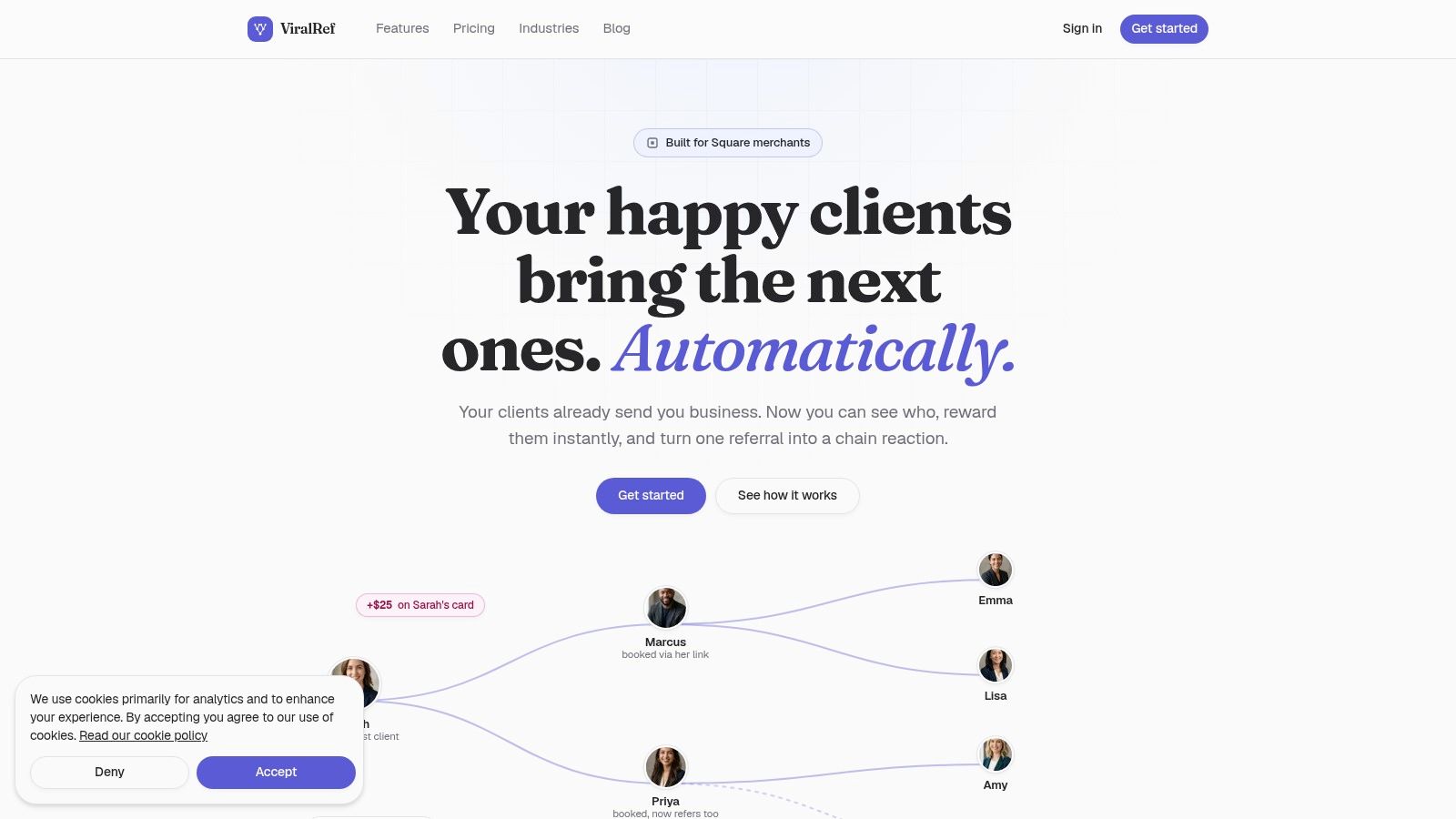
A personalized referral program should fit the way your Square business already operates. ViralRef is the only referral program built natively for Square, and it can connect referral activity with the customer and payment flow you already use.
Start with a clear setup:
- Connect your Square tools: Link the program with Square POS or Square Appointments so referrals can lead to trackable customer activity.
- Give clients an easy sharing method: Each customer can receive a referral link and branded portal, accessible by phone number without requiring an app. QR codes and social sharing make it easier to recommend the business from a phone.
- Choose rewards that fit your business: In-house gift cards can encourage a return visit. Coupons can apply at Square POS, Virtual Terminal, and Invoices. Pick the option your staff can explain without hesitation.
- Create groups and tiers: Treat a first-time referrer differently from a client who regularly brings new people. You can also create separate arrangements for staff, ambassadors, or influencers.
- Review the dashboard: Track referral performance, rewards, revenue attribution, conversion rates, and retention so you can see which advocates bring valuable new bookings.
Make the experience easy for staff
Train the team on one natural sentence, such as, “If you know someone who would enjoy this service, your referral link is in your client portal.” Staff don't need to deliver a sales pitch. They need to mention the program at moments when the client has just expressed satisfaction or complimented the service.
Square's 2026 survey of salon and barber clients found that 85% said easy booking influenced their choice, while 82% valued easy rescheduling and 75% valued better communication between appointments. Square's client loyalty findings support a straightforward principle: your referral flow should be as convenient as the appointment flow.
ViralRef can automatically attribute payments, calculate commissions, and top up gift cards in real time. Its fraud detection can flag self-referrals, duplicates, rapid conversions, and disposable email addresses for review without automatically rejecting them. For practical details on reducing manual work, automating a referral program with ViralRef Smart Features explains the operating approach.
Measuring Success and Optimizing Over Time
Personalization only improves when you measure the behavior behind the result. Don't judge a campaign solely by how many people opened a message or clicked a link. Ask whether the right clients returned, referred someone suitable, and generated a relationship your team can maintain.
Use ViralRef analytics alongside Square reports to review:
- Referral conversion: How many shared recommendations become new bookings or purchases?
- Referral quality: Do referred clients return, book valuable services, or remain one-time visitors?
- Client retention: Are the segments receiving relevant follow-up returning more consistently?
- Revenue per client: Which groups create dependable value without requiring constant discounts?
- Reward cost: Does the incentive produce enough repeat business or new customer value to justify itself?
A useful review starts with one segment and one change. Compare a gift card with a coupon, or test a practical reminder against a warmer thank-you message. Keep the timing and audience consistent enough that you can learn from the result rather than changing everything at once.
Measure the relationship, not just the transaction.
Review results on a regular schedule that suits your workload. Look for patterns in Square Appointments, Square POS, and referral records. If VIP referrers respond well to recognition but poorly to discounts, adjust the reward. If new clients book once and disappear, improve the first-visit follow-up instead of sending more broad promotions.
A focused reporting and analytics workflow helps turn those observations into decisions. Personalization isn't a one-time campaign. It is the ongoing practice of noticing what clients do and improving how your business responds.
Your Personalized Growth Path Forward
Sarah doesn't need to personalize every interaction on day one. She can start by identifying her most loyal clients, recording the preferences the team already knows, and creating a simple referral thank-you that fits the salon. Then she can watch which clients share, which referrals book, and which new customers return.
That approach builds more than a promotion. It makes the client relationship visible and gives happy customers a clear way to introduce friends. Personalization can also support acquisition efficiency. McKinsey's research notes that it can reduce customer acquisition costs by as much as 50% and increase marketing ROI by 10% to 30%.
For Square salons, barbershops, spas, and fitness studios, the competitive advantage is often simple: remember people, make booking easy, and thank them properly when they bring someone new. The businesses that do this consistently will stand out as digital tools become more common.
ViralRef gives Square merchants a native way to turn client referrals into trackable links, rewards, and new bookings, while fitting around Square POS and Square Appointments. Visit ViralRef to set up a personalized referral program that helps your happiest clients bring more of the right people through your door.
Related articles
Churn Rate Calculation for Square Merchants: A Simple Guide
Learn churn rate calculation for your salon or studio. A simple guide for Square merchants to measure client loss and find solutions with ViralRef.
Geofencing Marketing for Square Merchants: A Simple Guide
Learn how geofencing marketing can attract new clients to your salon, spa, or studio. A plain-language guide for Square merchants on setup, use cases, and KPIs.
Community Building Strategy for Square Merchants
Learn a proven community building strategy for Square merchants that turns loyal clients into a steady stream of new bookings with simple referral tools.