How to Thank Clients for Their Business the Right Way
Learn how to thank clients for their business with practical, Square-friendly tactics. Real message examples, gift ideas, timing tips, and automation workflows.
A client leaves your salon smiling after a great appointment. The payment is complete in Square POS, the result looks excellent, and you know they're happy. Then the awkward question appears: should you hug them, send a text, email a Square gift card, or say “Thanks for coming in”?
The right answer is to make appreciation specific, fast, and connected to what happens next. A thank-you should help create the second booking, the next visit, or a measurable referral, not just sit in someone's inbox as a pleasant but forgettable message.
For Square merchants, the best approach combines a personal gesture with a simple workflow. Use Square POS, Square Appointments, Square Loyalty, and a referral system to recognize the client while the appointment is still fresh. This guide shows you how to thank clients for their business with practical channels, message templates, gift tiers, and a referral loop you can start using immediately.
Table of Contents
- The Moment Right After a Great Appointment
- Why Gratitude Pays for Itself
- Choosing the Right Channel for Each Client
- Thank-You Messages That Don't Sound Like a Robot
- Small Gifts and Reward Ideas That Fit a Service Business
- Timing and Segmentation That Make It Personal
- Turning Thank-Yous Into a Referral Engine With ViralRef and Square
The Moment Right After a Great Appointment
A salon owner watches a long-time client walk out smiling after a $180 color service. The client loves the tone, compliments the stylist, and says she'll see everyone soon. The owner wonders whether the right response is a hug, an email, or a Square gift card.
That moment matters more than most owners realize. The client has just experienced the result, the conversation, and the care your team provided. A thank-you delivered during that same appointment window reinforces the feeling before the client gets distracted by traffic, work, errands, and the rest of the day.
I call the first 24 hours after checkout the gratitude window. You don't need to wait for a birthday, anniversary, or major loyalty milestone. Send appreciation while the client can still connect it to the service and the person who delivered it.
Practical rule: Thank the client for the specific outcome, not merely for spending money.
A barber might say, “I'm glad we got the shape around your temples exactly where you wanted it.” A fitness coach might follow a first class with, “You kept your form strong through the final set.” A spa manager might mention the treatment the client selected and the concern it addressed. Specific recognition feels earned because it couldn't have been sent to anyone.
Your follow-up can also invite useful feedback without turning into a survey ambush. The closed-loop feedback process helps you connect the client's response to a staff action, service improvement, or recovery step.
The rest of your workflow should stay simple:
- Acknowledge the service quickly.
- Mention one real detail from the visit.
- Offer a natural next step, such as rebooking, feedback, or sharing with a friend.
- Track the action inside the tools you already use.
A thank-you isn't a footnote after checkout. It's the first move in the relationship that can lead to another booking and a new client.
Why Gratitude Pays for Itself
Gratitude has a business case, but don't confuse it with a discount campaign. A 2014 restaurant study found that a simple thank-you from the company president increased repeat patronage by more than 50%, with repeat visits rising 50% for men and 57% for women over the following 12 months. The study summary also reported that the thank-you email performed just as well as messages paired with gift cards and guaranteed reservations.
That finding is useful for salons, barbershops, spas, and studios because it separates appreciation from heavy discounting. A client may return because they felt remembered, not because you immediately reduced the price.
Retention economics make the same point. Broad customer-retention research places the cost of acquiring a new customer at 5x to 25x more than keeping an existing one, while a 5% increase in retention can raise profits by 25% to 95%, as summarized by customer-retention research and loyalty data. Deloitte's 2024 global consumer loyalty survey found that 86% of respondents considered financial rewards, simplicity, and ease of use important or very important loyalty-program attributes.
A simple example shows how to think about the math. If your average ticket is $90, every retained visit preserves revenue from a client you've already acquired. If a gratitude touchpoint produces a 20% lift in repeat visits, the result is not automatically profit, because you still need to account for labor, supplies, and capacity. But Square reporting can show whether those clients rebook more often than comparable clients who received no follow-up.
Gratitude vs. Discount
| Tactic | Cost per Client | Repeat Visit Lift | Referral Rate | Net Revenue Impact |
|---|---|---|---|---|
| Personal thank-you | Staff time or a small card | Track in Square | Track with a referral link | Protects margin when it leads to rebooking |
| Immediate discount | Reduced service revenue | Track in Square | Track separately | Can fill a slot but lowers the ticket |
| Thank-you plus referral reward | Message cost plus qualified reward | Track in Square | Attributed through referral activity | Connects appreciation to new bookings |
A thank-you won't repair poor work, replace local marketing, or make an unhappy client ignore a service problem. Fix the experience first. Then use appreciation to strengthen a good one.
Appreciation is cheap, trackable, and compounds.
Choosing the Right Channel for Each Client
Don't send every client the same message through the same channel. The right channel depends on how often they visit, how much attention they deserve, and what action you want next.
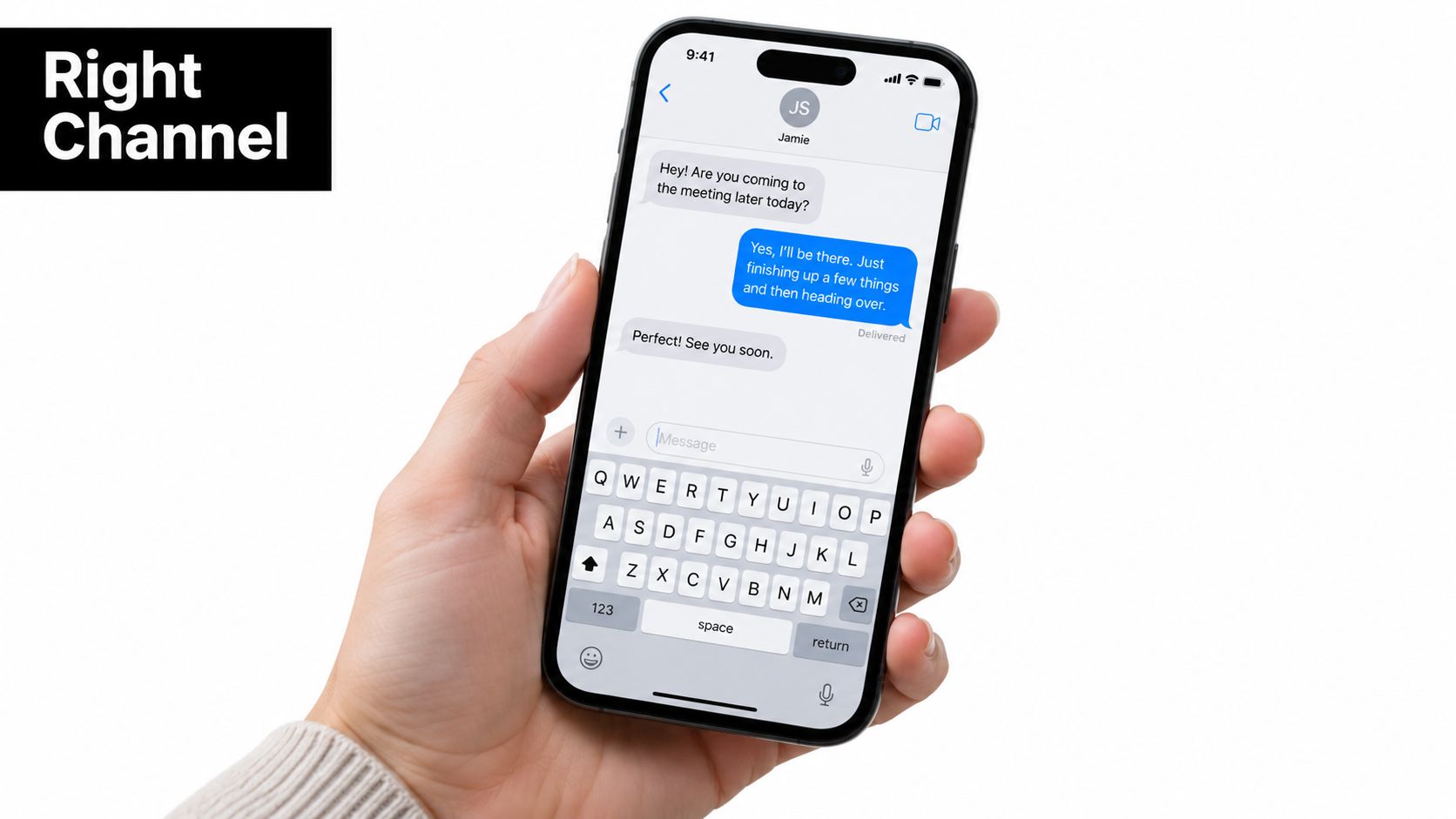
SMS for frequent clients
Use SMS when a client already communicates comfortably by text and the service happens often. Send it within an hour of checkout, keep it under 160 characters, and reference the appointment.
A barbershop might text: “Marcus, that taper came out clean. Thanks for coming in today. Want me to hold your usual time for the next visit?” The trigger is a completed Square Appointments booking or a completed payment in Square POS.
SMS works because it reaches the client while the experience is still current. Don't turn the message into a product catalogue or a long promotion. For campaign planning, use texting for campaigns as a reference for keeping outreach focused.
Email for a fuller follow-up
Email suits a client who needs aftercare, a longer recap, or a convenient rebooking link. A spa can email treatment notes, thank the client for choosing a particular service, and include a Square Appointments booking link. A studio can recap a first class and point the client toward the next session.
Square Email Marketing can handle the communication, while Square Gift Cards can provide a practical reward when one is appropriate. Keep the thank-you at the center. If the first paragraph sounds like an advertisement, rewrite it.
Handwritten notes for valuable moments
A handwritten note deserves manual effort. Use it for a $200+ ticket, a third visit, a major transformation, a long-term client milestone, or a referral source.
A colorist might leave a note at checkout after a complex correction service: “Thank you for trusting us with such an important change. We loved seeing the finished color come together.” The trigger can be a high-value completed payment or a customer profile flagged for personal follow-up.
Direct-mail guidance cited in the provided business benchmark reports 4.9% response for direct mail versus 0.6% for email, while another benchmark reports handwritten notes can lift response by up to 300% and retention by 37% in some programs. Treat those figures as directional benchmarks, not promises for your shop. Your own Square results matter more.
In-person appreciation for first-timers
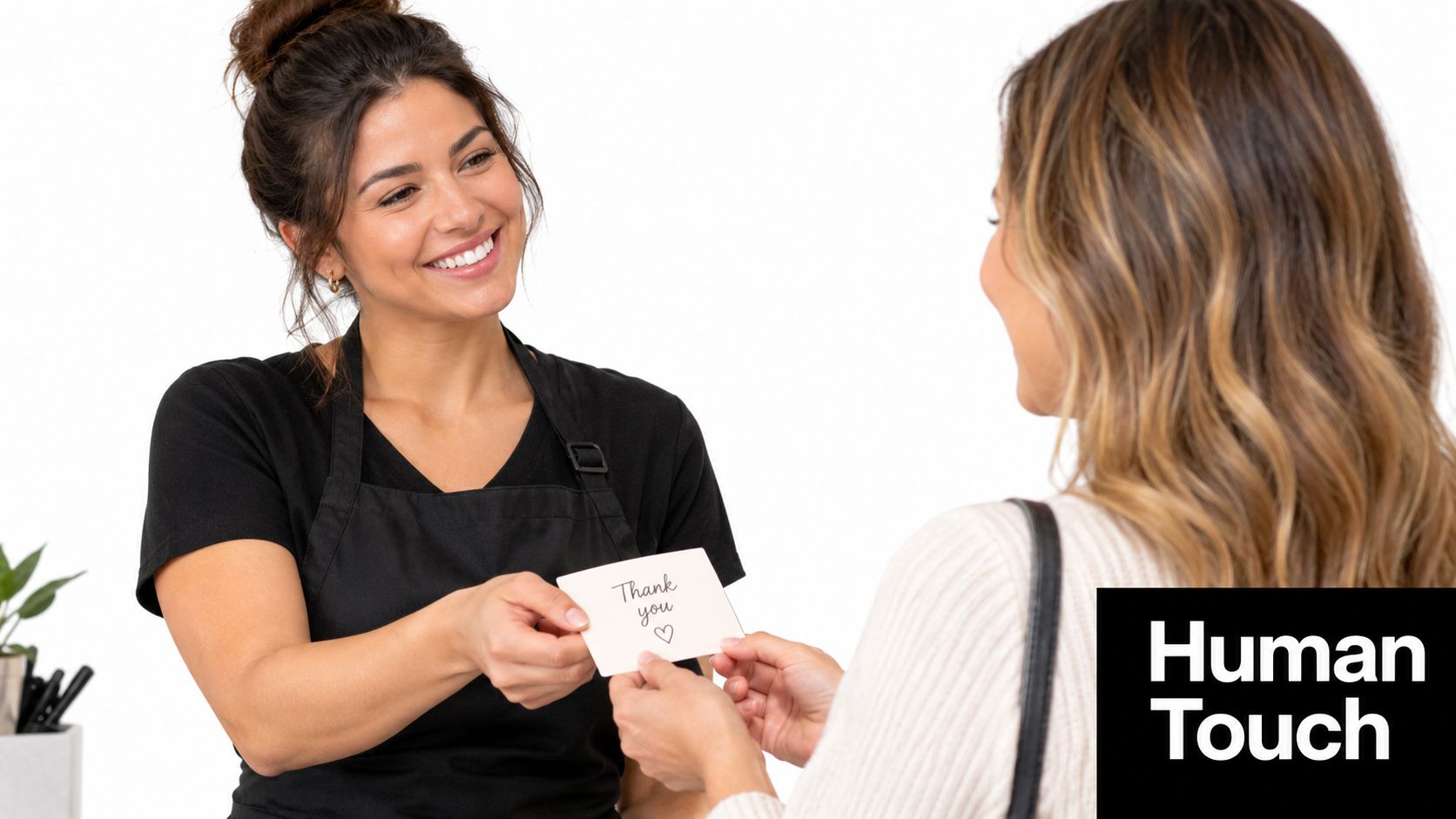
First-time clients and walk-ins need a human thank-you before they leave. The front-desk employee should use the client's name, mention the service, and make the next step easy.
“Thanks for giving us a try, Jamie. I hope the blowout holds well. We can help you book the next appointment before you head out.”
Small physical gifts for VIPs
Reserve physical gifts for VIPs, loyal advocates, and people who refer qualified customers. A spa might provide a branded self-care item. A studio might offer a useful accessory connected to the client's routine. A referral source might receive a carefully chosen thank-you rather than a random promotional item.
Your default mix should be simple: in-person thanks for everyone, automated SMS or email after a positive visit, and handwritten or physical gestures for high-value clients and referral sources.
Thank-You Messages That Don't Sound Like a Robot
Generic phrases fail because they contain no evidence that you remember the client. “Thanks again” and “We appreciate your business” could be pasted into every message without changing a word.
Replace the general statement with one detail from the appointment, one value statement, and one soft next step. These templates show the structure.
Salon message
“Hi Jamie, thanks for letting Sarah fix what the humidity did to your color. The warmer tone suits you, and the shine came back beautifully. If you'd like, you can grab your next color appointment through our Square booking link. Hope you enjoy it.”
The heavy lifting comes from “fix what the humidity did to your color”, which proves the message relates to Jamie's visit. “The warmer tone suits you” connects the service to a visible result. The booking link offers a next action without pretending the thank-you is a sales pitch.
Fitness studio message
“Great work today, Alex. You stayed with the class through the final round and kept your form strong. Thanks for training with us. If you'd like another session this week, your usual class is open in Square Appointments.”
The coach recognizes behavior, not just attendance. “Stayed with the class through the final round” is personal, while the class link makes rebooking convenient.
Spa message
“Thank you for spending part of your day with us, Priya. We hope the scalp treatment gave you the reset you needed after a busy week. Drink some water, take it easy tonight, and message us if you have any questions about your aftercare.”
This message doesn't force a booking or referral. It reinforces care after the service and tells the client what happens next. That follow-through builds trust.
For mailed notes, the Firacard thank you card templates can help your team find a suitable format before adding the personal detail that makes the card yours.
You can adapt the same structure for email, but don't inflate a short thank-you into a newsletter. The email blast examples are useful for understanding layout and clarity, while your post-appointment message should remain focused on one client and one next step.
Small Gifts and Reward Ideas That Fit a Service Business
A flat gift policy wastes money. The client who visits once shouldn't automatically receive the same reward as the advocate who books regularly and sends friends.
Use layers tied to client value, behavior, and the action you want to encourage. Square-native rewards keep the cost visible instead of letting appreciation disappear into untracked spending.
Reward tiers for service businesses
| Client tier | Trigger | Suggested gift | Square mechanic |
|---|---|---|---|
| Every paying client | Completed appointment or purchase | Add-on upgrade, digital thank-you, or points boost | Square POS, Square Messaging, or Square Loyalty |
| Repeat client | Third visit or meaningful return pattern | Handwritten note, Square Gift Card, or branded item under $15 | Customer Directory and Gift Cards |
| VIP or advocate | High spend, major milestone, or qualified referral | Personalized gift plus referral reward | Square Gift Cards, Square Loyalty, and ViralRef |
Tier one should feel generous without creating a large cost. A salon might add a conditioning upgrade. A fitness studio could add a loyalty-points boost. A spa could send a digital thank-you through Square Messaging.
Tier two is where personal recognition starts to matter. Load a Square Gift Card in-store, write a note, or give a small branded item under $15. Use the client profile to record why the reward was issued.
Tier three deserves more thought. Pair a meaningful gesture with a referral offer that gives the client a reason to share. Referral guidance recommends clear, symmetrical rewards, such as giving the friend a discount on a first haircut and giving the referrer a discount on the next visit. Another practical example offers $15 off a friend's first visit of $75 or more, with $15 off the referrer's next visit. These structures are described in small-business referral-program guidance.
Don't guess at expensive gifts. For a polished client or partner gift, resources such as ROCKS Whiskey Chilling Stones client gifts can help you choose something more distinctive than generic swag.
Set gifts up as zero-margin items in Square inventory and reconcile them against your marketing line. The common mistake is over-gifting low-value clients while under-rewarding the people who drive repeat revenue and referrals.
For referral-specific reward design, review rewards for referrals and keep the rule simple: the reward should be activated after the referred person completes a qualifying purchase.
Timing and Segmentation That Make It Personal
Personalization doesn't mean writing every message from scratch. It means using the information already in your systems to decide who gets a personal note, who gets an automated message, and what each person should be invited to do next.
Start with three filters.
Lifetime spend
Square customer profiles show who has generated meaningful revenue over time. A client with more than $500 in lifetime spend should hear from the owner personally within 24 hours of a strong appointment. Don't send that client the same automated message as a first-time walk-in.
Tenure
The first-visit date tells you whether someone is new, returning, or established. A first-visit client can receive an automated Square Message with a points reward and a clear invitation to book again. A long-term client may deserve a note that recognizes the relationship rather than another introductory offer.
Referral history
Referral history adds context that Square alone may not provide. Export or review the activity connected to your referral program, then separate clients who have already referred someone from those who have never shared.
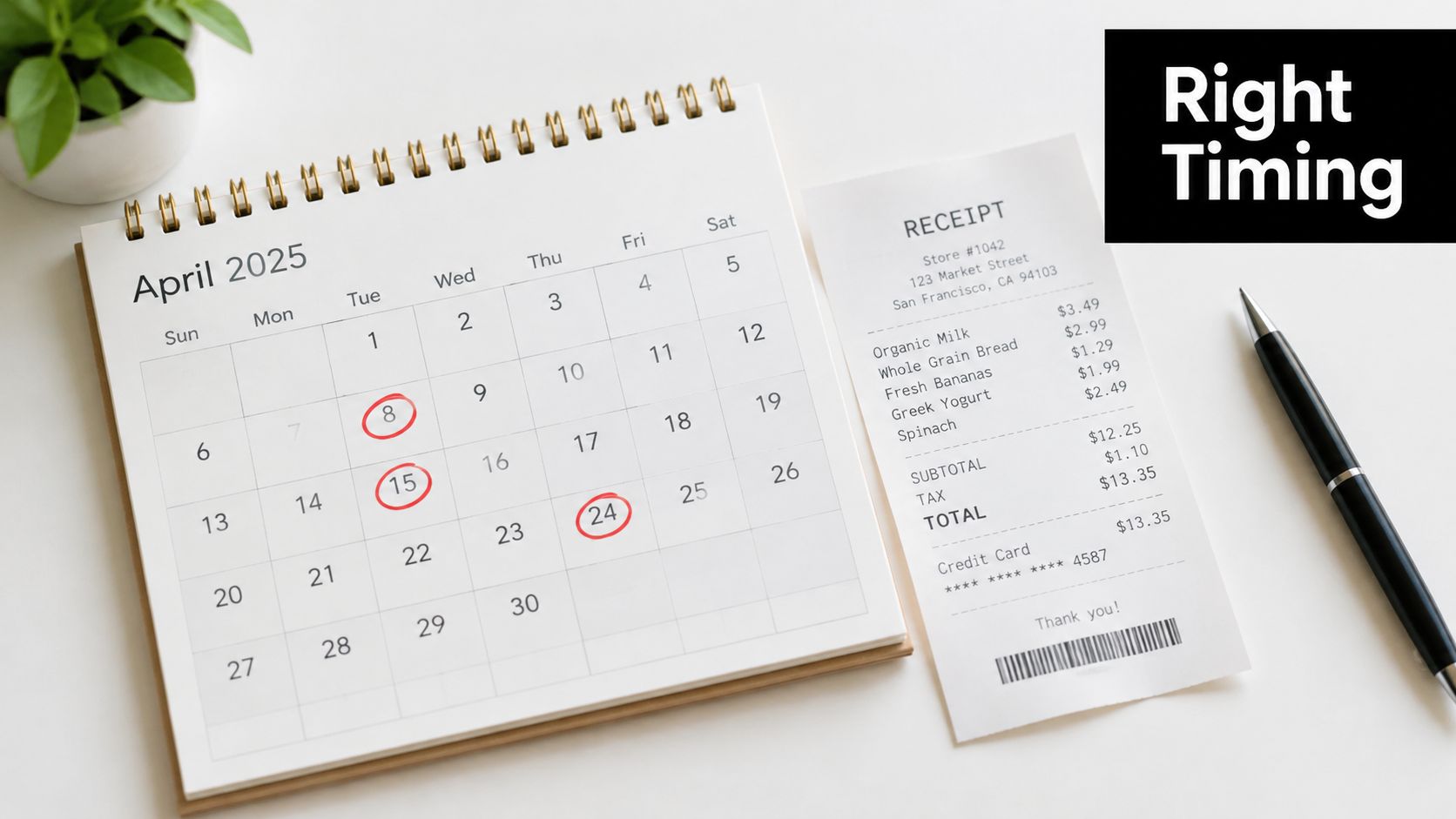
The strongest targeting combines the filters. A client who joined last month, has spent under $200, and has referred zero friends needs reassurance, a service-specific thank-you, and an easy rebooking prompt. A five-year client who has spent $2,000 and sent several friends needs owner-level recognition, a personal gift, and a referral reward that reflects their advocacy.
Don't blast every segment on the same Monday email cadence. A scheduled batch may be efficient for your team, but it makes a personal gesture feel like another ignored promotion.
The trigger should come from the client's behavior, not your calendar.
Use Square Appointments for visit events, Square POS for completed payments, Customer Directory for history, and Square Loyalty for repeat-visit recognition. Then set different follow-up rules for new clients, returning clients, VIPs, and referral sources.
Turning Thank-Yous Into a Referral Engine With ViralRef and Square
A thank-you becomes commercially useful when it connects appreciation to a trackable action. For Square merchants, the loop should begin after payment and end when a referred client books and pays.
The five-step loop
- Square records the completed purchase. A post-purchase trigger starts inside Square POS or after a completed Square Appointments service.
- The client enters a referral workflow. The contact carries useful context, such as spend, service type, and tenure.
- The client receives appreciation and a sharing option. Send a personal thank-you by email or SMS, then include a trackable referral link. Pair it with a Square Gift Card, Square Loyalty reward, or store-credit offer when appropriate.
- The referred friend books and pays. The new client uses Square Appointments or completes payment through Square POS.
- The original client receives credit. The system attributes the referral and reports the resulting revenue so you can see who created the booking.
ViralRef is the only referral program built natively for Square. It connects referral tracking with gift-card rewards and lets merchants use tools such as Customer Directory, Gift Cards, Loyalty, and Email Marketing sync in the workflow. Its reward options can include affiliate-style commission or store credit, depending on how you want to recognize clients, staff, or other referral partners.
Consider Sofia, a salon client who spends $180, leaves a five-star review, and receives a $20 Square Gift Card with a referral link. Sofia shares the link with Maria. Maria books a $95 service, and the dashboard shows that Sofia drove $95 of new revenue. That example gives the owner something a generic thank-you card can't provide: a clear connection between appreciation, advocacy, and a paid appointment.
Recent consumer research also supports making the recognition concrete. A 2026 Journal of Consumer Research study examined 176,237 food-delivery orders and nine experiments, finding that materially referenced tip recommendations increased tips. The broader lesson for service businesses is straightforward: name the specific action and the specific reward instead of saying, “Tell your friends about us.” The Journal of Consumer Research study provides that research context.
Track one starting metric: referred customers who complete a paid visit. Don't begin with every possible dashboard view. Count qualified referrals, compare the reward cost with attributed revenue, and watch whether referred clients return.
Your tomorrow checklist
- Export or review recent completed payments in Square.
- Choose the appointment event that triggers a thank-you.
- Write one service-specific SMS and one email.
- Create a simple referral offer with a qualifying purchase rule.
- Connect the offer to a Square Gift Card, Loyalty reward, or store credit.
- Send the message to a small group first.
- Check which referred customers completed a paid booking.
Use earn and refer to shape the client-facing explanation, then keep the offer short enough for a stylist, barber, coach, or front-desk employee to explain in one breath.
ViralRef gives Square merchants a practical way to turn a timely thank-you into a tracked referral, with referral links, client rewards, and attribution tied to completed purchases. Visit ViralRef to connect appreciation with rebooking, gift cards, and measurable word-of-mouth growth.
Related articles
Service Business Marketing: A Playbook for Square Merchants
Your complete service business marketing playbook. Learn to attract and retain clients for your salon or studio with local SEO, referrals, and Square.
10 Affiliate Marketing Business Ideas for Salons & Spas
Discover 10 affiliate marketing business ideas for salons, spas, & studios. Leverage Square clients & staff to drive growth with these actionable strategies.
How to Design a Business Punch Card Program That Works
Learn how to design a business punch card loyalty program for your salon, spa, or studio. Covers rewards, Square setup, fraud prevention, and templates.