How to Generate More Customers for Your Service Business
Learn how to generate more customers for your salon, spa or studio with referrals, local partnerships and ViralRef for Square. Practical playbook inside.
A lot of service owners hit the same wall. The Instagram posts are going out, the front desk is answering the phone, and the work itself is strong, but next week's calendar still has holes in it.
That's usually the moment people start asking how to generate more customers. They look at ads, discounts, another posting tool, maybe a freelancer to run campaigns. Some of those things can help. But for salons, barbershops, spas, and fitness studios on Square, the issue usually isn't reach. It's that too few happy clients are being turned into trusted introductions.
That matters because service businesses are bought differently. A haircut, facial, massage, or class membership is personal. People want a recommendation they trust before they book. McKinsey research cited by Review42 says word-of-mouth is the primary factor behind 20% to 50% of purchasing decisions, and the same source says it influences about 13% of all purchases worldwide through an estimated $6 trillion in annual global consumer spending (referral marketing statistics from Review42). If you've ever heard a new client say, “My friend told me to come here,” you've already seen the strongest growth channel in your business.
Table of Contents
- Why Service Businesses Struggle to Generate More Customers
- Diagnose Your Current Customer Generation Gaps
- Build Your Referral Engine With ViralRef for Square
- Expand Reach With Local Marketing Staff and Influencer Partnerships
- Choose the Right Rewards Promotions and Bounties
- Measure Results Prevent Fraud and Keep Growth Compounding
Why Service Businesses Struggle to Generate More Customers
A salon owner might have a full Friday and a half-empty Tuesday. A fitness studio might get strong January traffic, then watch attendance soften by spring. A spa might have five-star reviews and still feel like bookings come in waves.
The common mistake is treating this like a lead problem.
The real bottleneck is trust
Service businesses don't sell a generic product. They sell judgment, experience, and consistency. A guest doesn't just want a haircut. They want to know the stylist will listen. A first-time client doesn't just want a facial. They want to know the provider is clean, reliable, and worth the time.
That's why referrals outperform cold traffic so often. Research summarized by Extole reports that 92% of people trust recommendations from friends and family more than any other form of advertising, and referred customers make 27% more purchases, spend 28% more, and have a 37% higher retention rate than customers acquired through paid channels (referral marketing benchmarks summarized by Extole).
For a salon or studio, that changes the math. One happy regular isn't just repeat revenue. That person can become a repeating source of new clients.
Practical rule: If your business depends on repeat visits and personal trust, referrals shouldn't sit in the “nice to have” bucket.
Why ads often feel expensive and fragile
Paid media can still play a role. Local search ads, promoted posts, and retargeting can all support demand. But they're rarely the most stable foundation for a service business with a limited budget and a busy front desk.
The problem isn't that ads never work. The problem is that they stop the moment you stop paying, and they usually need sharper offers, stronger creative, and tighter follow-up than owners expect. If you're trying to support ads too, this guide to automated local advertising gives a useful look at how some local businesses reduce manual campaign work.
Referrals behave differently. Independent benchmarking summarized by Worldmetrics reports that referral programs can reduce customer acquisition cost by 35% to 45% compared with advertising, and referral-driven acquisition can cost about $15 to $25 per customer versus $50 to $75 for paid search (referral cost benchmarks from Worldmetrics).
What this looks like on the ground
A barber finishes a great cut. The client smiles, rebooks, pays through Square POS, and leaves. If nobody asks for a referral, gives them an easy share link, or tracks who they send, that moment disappears.
That's the leak.
Owners often assume word-of-mouth is “already happening.” Sometimes it is. But informal word-of-mouth is unpredictable. A system turns it into something you can count on when paid channels get noisy, costly, or inconsistent.
Diagnose Your Current Customer Generation Gaps
Before changing anything, look at where your customer flow breaks. Most owners don't need more tactics. They need fewer leaks.

Square already holds most of the clues. Square POS shows who's spending. Square Appointments shows who's rebooking, ghosting, or dropping off after one visit. If you're not already reviewing trends monthly, this piece on small business analytics habits is a good companion to that process.
Check where new clients actually come from
Start simple. Pull a recent list of first-time customers and ask how many came from:
- Direct recommendation: A friend, partner, family member, or coworker told them to book.
- Reviews and maps: They searched locally, then chose you based on ratings and comments.
- Social content: They found a reel, post, or story and booked from there.
- Paid traffic: An ad, sponsored result, or paid promotion got them in.
You don't need perfect attribution to see patterns. You need honest patterns. If a large share of your best clients arrived because someone vouched for you, that tells you where to invest operational effort.
Look for the three common leaks
Most service businesses lose referrals in the same three places:
- No clear ask moment: Staff finish the service, ring up the payment, and move on. Nobody asks at the moment when the client is happiest.
- Too much sharing friction: Clients would refer, but the process is awkward. They have to remember a name, search for the business later, or explain the offer manually.
- No tracking at all: Owners hear “we get lots of referrals” but can't tell which team member asked, which guest shared, or which referrals turned into paying customers.
If you can't see who referred whom, you can't improve the channel. You can only hope it keeps working.
Audit staff behavior, not just marketing
This part gets skipped all the time. A front desk script can outperform another month of posting.
Watch the handoff at checkout. Does the stylist mention rebooking but never mention sharing? Does the studio coach encourage reviews but not referrals? Does anyone show the client a QR code, text link, or a fast way to send an invite before they leave?
A referral engine fails in real life when it asks staff to remember too much.
Give yourself a rough score
Use a simple pass-or-fail review:
- Ask moment exists: Is there a repeatable point in the visit when someone asks for a referral?
- Share path is easy: Can a client share in seconds from their phone?
- Reward is clear: Does the client understand what they or their friend gets?
- Tracking is connected to payment: Can you tie a referral to an actual Square transaction?
- Staff know the script: Can every team member explain the program in one sentence?
If you fail on three or more, don't add more marketing noise. Fix the operating system first.
Build Your Referral Engine With ViralRef for Square
Once the gaps are clear, the next move is to stop managing referrals with memory, DMs, and front-desk sticky notes. For Square merchants, ViralRef is the only referral program built natively for Square, which matters because service owners need the reward, attribution, and payment flow tied to the same system staff already use.
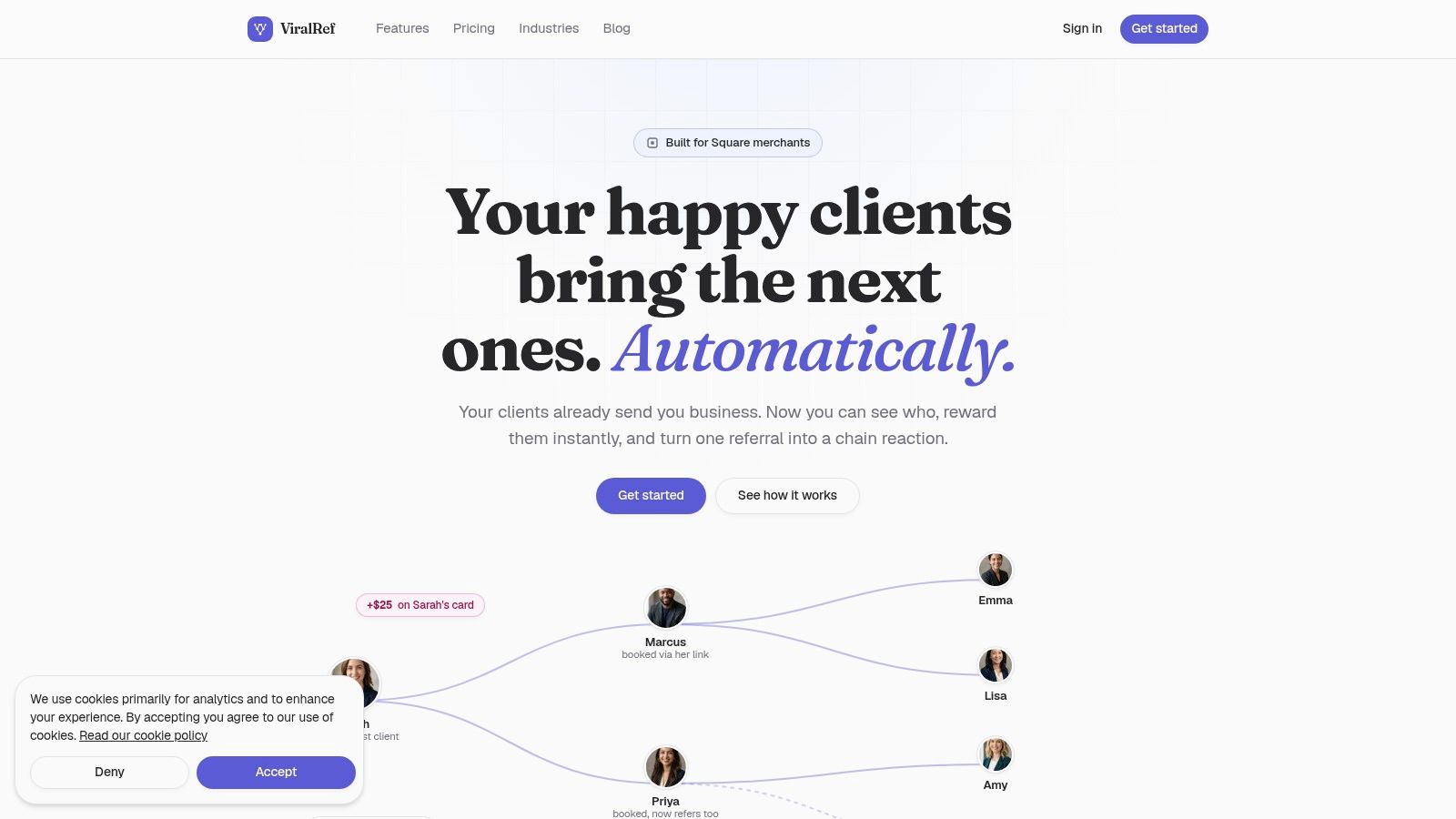
If you want the product details, the Square integration page shows how the connection works without extra apps for the customer.
Start with the Square connection
The first win is operational. When a referral tool connects directly to Square, you're not asking staff to maintain separate spreadsheets, coupon logs, and payout notes. The setup can sit close to the checkout flow they already know.
In practice, that means:
- Square POS stays the payment hub: Staff don't need to learn a whole second checkout system.
- Square Appointments stays part of the booking rhythm: Referral activity supports bookings instead of living outside them.
- Square payment events drive attribution: The reward can trigger when the referred person pays, not when they just click.
That last point matters more than most owners realize. Benchmark data summarized by SHNO says referral marketing can deliver 3x to 5x higher conversion than other channels, but only when attribution and reward logic are tightly connected to actual purchases rather than clicks alone (referral conversion benchmarks from SHNO).
Make sharing easy enough for a busy client
The strongest setup is simple on the customer side. A client shouldn't need to download anything, create a new login, or ask the front desk for help after they leave.
A workable flow looks like this:
- The client finishes their appointment.
- They pay through Square POS.
- They access a branded referral portal with their phone number.
- They get a unique referral link and QR code.
- They share it right away with a friend.
That speed matters. GrowSurf's 2026 statistics page reports that 78% of successful referrals happen within the first 48 hours of initial sharing, with email accounting for 33% of referral shares and social media 28% (referral timing and channel data from GrowSurf).
For salons and studios, the lesson is straightforward. Don't wait three days and hope the client remembers. Catch the referral window while satisfaction is fresh.
Front desk rule: Ask right after the service, not a week later when the emotional peak is gone.
Use rewards that work at the register
Many programs get clunky. The offer sounds good in theory, but staff can't redeem it cleanly, so nobody trusts the process.
A practical Square-based setup usually uses one of two reward mechanics:
- Gift cards: Good when you want to keep value in-house and bring the referrer back.
- Auto-applying coupons: Good when you want to lower friction for the new customer and make the first visit easier to say yes to.
When those rewards work inside Square POS, Virtual Terminal, or Invoices, your staff doesn't have to improvise. The checkout flow stays clean.
Here's a real service-business example. A stylist finishes a color appointment and says, “If you know someone who's been looking for a new stylist, send them your link. When they come in and pay, your reward is added automatically.” That line works because it's short, believable, and easy to act on.
Give owners visibility without extra admin
A lot of owners want referrals, but they don't want one more dashboard that creates one more job. The system has to answer useful questions fast:
- Who is sending referrals?
- Which shares become bookings?
- Which bookings become paid customers?
- Are certain staff members or client segments referring more than others?
- Which rewards are producing real business, not just casual sharing?
If you're also tightening your marketing workflow more broadly, tools like the entry-level LunaBloom subscription can help merchants organize content and campaign tasks around the referral engine rather than layering on random promotions.
Keep the script natural
The strongest programs don't sound like programs.
A barbershop might say, “If your friend books from your QR code, we'll take care of you on the next visit.” A fitness studio might put the share prompt right after class pack purchase. A spa might train the front desk to mention it when a client is glowing after a treatment and already talking about bringing a sister or friend.
The system handles tracking. Staff handle the human moment. That's the combination that fills calendars without turning your team into telemarketers.
Expand Reach With Local Marketing Staff and Influencer Partnerships
Once your referral process works with regular clients, the next layer is expanding who carries your message. Most local service businesses already have an underused marketing team. It just doesn't look like a marketing department.
It looks like stylists, coaches, front desk staff, neighboring businesses, and a few local creators who already influence where people book.

For service businesses, this works best when everyone has a clean way to refer without creating payout confusion. The article on building a team referral network is useful if you're setting this up across staff roles.
Turn staff into active referrers
Staff usually know who's happy before the owner does. They hear the comments, see who rebooks immediately, and know which clients bring friends.
The mistake is giving the team a vague instruction like “ask for referrals more often.” That rarely sticks.
A better model gives each staff member their own referral identity. That can be their own link, their own QR code, and their own view of what's converting. Then the ask becomes part of the service rhythm.
For example:
- A stylist shares their code at checkout after a strong transformation appointment.
- A trainer drops their link into a follow-up text after a member hits a milestone.
- A front desk lead reminds a regular that their referral reward is ready to use.
That's easier to repeat because each person can see that their asks produce actual bookings.
Use local partnerships that make sense
The best local partnerships aren't random. They're adjacent.
A salon can partner with a bridal makeup artist, photographer, medspa, or boutique. A barbershop can connect with a nearby coffee shop, menswear store, or tattoo studio. A fitness studio can work with a healthy café, chiropractor, or physical therapist.
Keep the pitch simple. Explain who your ideal customer is, what kind of referral you want, and how the reward works. Don't dump a full marketing deck on a local owner who's also trying to run payroll and open the doors on time.
Good local partnerships feel like a warm handoff, not a co-branded campaign.
Add micro-influencers without making it messy
Local creators can help, especially in beauty, wellness, and fitness. But they create problems when there's no structure. Free services get handed out. Posts go live. Then nobody knows what booked, who earned what, or whether the audience matched the business.
A cleaner approach is to treat creators like trackable referral partners, not one-off hype machines. Give them a dedicated link, a simple offer, and a clear payout rule tied to completed customer action.
If you want a smart overview of how businesses are thinking about creator systems, Busylike's approach to AI in marketing is worth reading because it focuses on scaling partnerships without drowning in manual coordination.
Keep human moments at the center
This only works if the ask still feels local and personal.
A yoga studio owner doesn't need an influencer roster before they've taught staff to invite referrals after a packed class. A salon doesn't need five ambassadors if regulars still leave without a share prompt. Reach comes after rhythm.
The businesses that generate more customers consistently usually do one thing well. They make every happy interaction shareable, then they let staff and partners extend that reach in a structured way.
Choose the Right Rewards Promotions and Bounties
Not every referral needs the same incentive. The right reward depends on who's sharing, who's receiving it, and what behavior you want next.
Small-business referral benchmarks summarized by 4OVER4 note that referral programs often bring customer acquisition cost down to $10 to $50 per acquired customer, and that successful programs commonly see 2% to 5% of customers actively referring others (small-business referral benchmarks from 4OVER4). That's useful because it reminds owners they don't need every client to become a promoter. They need a manageable group of active referrers and a reward structure that doesn't waste margin.
Gift Cards vs Coupons vs Bounties at a Glance
| Reward Type | Best For | How It Works at Square | When to Use It |
|---|---|---|---|
| Gift Cards | Existing clients you want to bring back | Value stays in-house and is redeemed like store credit through the normal checkout flow | Use when repeat visits matter and you want the reward to lead to another appointment |
| Coupons | First-time referred customers who need a small push to book | The discount can be applied at checkout with less explanation for the new guest | Use when the main barrier is getting the first visit booked |
| Bounties | Staff, ambassadors, or clients during a specific push | A defined reward is tied to a target action or campaign period | Use during slow weeks, seasonal promotions, or a launch of a new service |
When gift cards make more sense
Gift cards are usually the cleanest option for salons, spas, and studios because they keep dollars inside the business. They also feel more like a thank-you than a price cut.
They work well when the person referring is already a regular. A stylist's client sends in a friend, the friend completes and pays for the appointment, and the referrer gets credit toward their next service. That keeps the loop going without training people to wait for discounts.
When coupons do the heavier lifting
Coupons are better when the referred friend needs a nudge. If you're introducing a new studio to someone who's comparing options, a simple first-visit discount can reduce hesitation.
The caution is obvious. If the reward is too aggressive, you attract bargain shoppers instead of long-term clients. That's why reward choice should follow customer quality, not just referral volume.
For a deeper breakdown of structures, this guide to referral reward types is worth keeping open while you decide.
Where Bounties fit
Bounties are useful when you want focused action for a short window.
Examples include:
- Slow midweek periods: Offer a temporary referral push tied to Tuesday or Wednesday bookings.
- New service launch: Create a short campaign around a new treatment, membership, or class format.
- Seasonal demand pockets: Tie rewards to gift-card season, back-to-school, wedding prep, or New Year fitness demand.
The mistake is overpaying for weak referrals. Don't reward loose sharing activity if you care about paid visits. Reward completed outcomes that matter to the business.
Measure Results Prevent Fraud and Keep Growth Compounding
Launching a referral program isn't the hard part. Keeping it clean and useful is.

The biggest shift is moving from “Did people share?” to “Did the right people share, and did those referrals turn into strong customers?”
Measure quality, not just activity
Recent referral commentary has pushed owners to look past lead count and focus on conversion, retention, average order value, and follow-up behavior in service businesses (referral quality and retention guidance from Mean CEO).
That's the right lens.
Review referral performance in this order:
- Conversion first: Which referral sources become paying customers?
- Retention next: Do referred clients come back and behave like regulars?
- Reward efficiency: Which incentives produce solid business without giving away too much?
- Top referrers: Which clients, staff, or partners consistently bring in good-fit customers?
One useful monthly habit is to review your best referrers by quality, not just count. One client who sends three loyal regulars is more valuable than someone who sprays out links with no serious bookings.
Optimize the right things in the right order
When referrals underperform, owners often change the reward first. That's sometimes correct, but not always.
A cleaner troubleshooting sequence is:
- Check incentive value: Is the offer meaningful enough to act on?
- Reduce sharing friction: Can people send it in seconds?
- Improve trust signals: Does the recipient land on a page and feel confident enough to book?
If the process is clunky, increasing the reward won't save it.
Prevent obvious abuse without punishing good customers
Referral programs attract edge cases. Self-referrals, duplicate attempts, fast suspicious conversions, and throwaway email behavior can muddy the data and create front-desk headaches.
That's why fraud controls matter. This overview of referral fraud detection systems is helpful if you want to understand the common patterns before they eat staff time.
Watch for weird patterns, but don't make honest customers jump through hoops just to share your business.
Keep the compounding loop alive
The referral channel compounds when you thank people quickly, keep the ask close to the appointment, and review performance often enough to adjust.
For the next 30 days, keep it simple:
- Ask at checkout or right after the visit
- Make sharing phone-first and immediate
- Reward only completed, meaningful outcomes
- Review top referrers and weak spots once a month
That's how to generate more customers without turning your growth plan into another job nobody has time to manage.
If you run on Square and want referrals to happen automatically instead of casually, ViralRef gives you a way to connect sharing, rewards, attribution, and fraud checks to the payment flow you already use. It's built for salons, barbershops, spas, and studios that want to fill calendars through word-of-mouth without adding front-desk busywork.
Related articles
How to Get WOM for Your Service Business
Learn how to get WOM for your salon, spa, or studio. Practical strategies to turn happy clients into a measurable, automated referral engine using Square.
Service Business Marketing: A Playbook for Square Merchants
Your complete service business marketing playbook. Learn to attract and retain clients for your salon or studio with local SEO, referrals, and Square.
10 Examples of Strategic Alliances for Your Business
Discover 10 real-world examples of strategic alliances and learn how your salon, spa, or studio can use similar partnerships to get more clients.